Overview
Barley is Australia’s second most important cereal crop, with production typically ranging from 8 to 13 million tonnes annually. It is a winter crop grown across the same broad regions as wheat, with the highest concentrations in Western Australia, South Australia and Victoria. Australia is one of the world’s top barley exporters and is particularly esteemed for its malting barley quality.
Barley performs well in low-rainfall environments and on lighter soils, making it a natural complement to wheat in rotation. For growers, the malting premium — typically $20–$60/t above feed prices — provides strong incentive to target malting quality through variety selection, agronomy and timely harvest management.
Two-Row vs Six-Row Barley
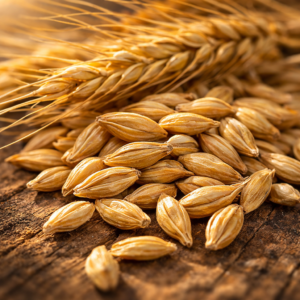
Australian barley is almost exclusively two-row type (Hordeum vulgare), which produces larger, more uniform grains with higher starch content and better extract – the key driver of malting quality. Six-row barley, more common in North America, is rarely grown in Australia.
🏛️ AMBA Accreditation
The Australian Malting Barley Assessors (AMBA) accredits barley varieties that meet malting quality standards. Only AMBA-accredited varieties are eligible for the malting grade premium. Growers should always check variety lists before planting.
🇨🇳 The China Trade Dispute
In 2020, China imposed 80%+ tariffs on Australian barley, effectively closing a market that had been taking ~50% of exports. The industry pivoted to Saudi Arabia, Japan and other markets. China’s tariffs were removed in 2023, revitalising export returns.
🍺 The Malting Process
Malting barley is steeped in water, allowed to germinate (producing enzymes), then kiln-dried. These enzymes convert grain starches to fermentable sugars during brewing. Low protein and high starch extract are the key quality targets.
📉 Feed vs Malting Premium
The malting premium fluctuates with global supply and demand. In strong malting markets it can reach $60–80/t over feed grade — a significant return for growers who manage crop quality carefully.
| Grade | Key Requirements | Primary Use | Key Markets |
|---|---|---|---|
| Malt 1 (M1) | AMBA variety; protein 9.0–12.5%; low screenings; good germination | Malting, brewing | China, Japan, Saudi Arabia, South Korea |
| Malt 2 (M2) | AMBA variety with minor specification deviations | Malting (secondary) | Various export markets |
| Feed 1 (F1) | Any variety; screenings under 15%; moisture under 12.5% | Stockfeed, stockfeed export | Domestic feedlots; Saudi Arabia, China |
| Feed 2 (F2) | Lower specification feed barley | Domestic stockfeed | Domestic use |