
Here is a number that should make you pause: Australia, a continent-sized agricultural powerhouse that exported $75.8 billion worth of farm products last financial year, produces roughly 400,000 tonnes of maize annually. That’s it. In a world that grows more than 1.2 billion tonnes of corn each year, Australia’s contribution barely registers as a rounding error. We produce less maize than Slovenia.
This is not because Australians don’t use corn. Feed grain demand from the beef feedlot, poultry, pig and dairy sectors has been climbing steadily for two decades, rising from around 5.7 million tonnes a year in the mid-1990s to an estimated 13.5 million tonnes by 2018–19. Wheat and barley do most of the heavy lifting in those rations, but maize—with its superior energy density and palatability—has a fixed domestic requirement of at least 200,000 tonnes for human food products like cornflakes, popcorn and corn chips, with any surplus flowing into stockfeed. The demand is there. The production, stubbornly, is not.
So what’s holding Australian maize back? And is the story finally starting to change?
A Crop Without a Natural Home
The fundamental challenge for maize in Australia is water. Corn is a thirsty crop. A fully irrigated summer maize crop targeting 15 tonnes per hectare requires reliable access to significant volumes of water through the hottest months of the year—precisely when Australian irrigation allocations are under the most pressure. In the Riverina and Murray districts of southern NSW, where much of the country’s irrigated maize is grown, water costs have risen sharply under the Murray-Darling Basin Plan. Maize Association of Australia chair Bernie Walsh has noted that many farmers have simply stopped growing irrigated corn because the economics no longer stack up against competing crops like cotton and rice that deliver better returns per megalitre.
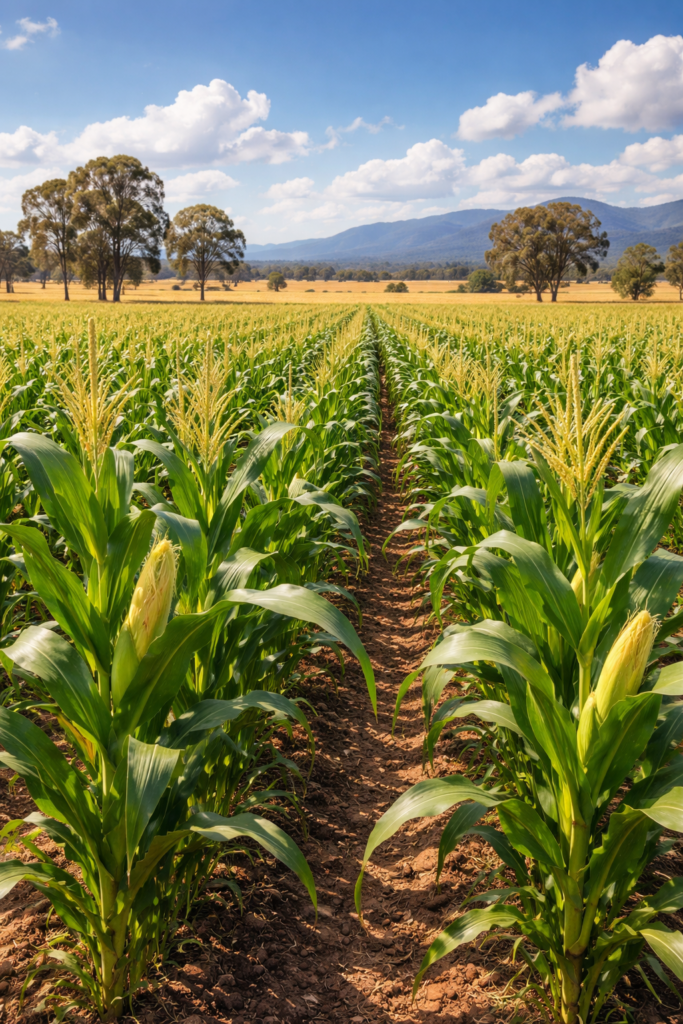
The crop’s geography tells the story. Australia’s main maize growing regions are the Riverina and Lachlan districts of central-southern NSW, the Darling Downs and Liverpool Plains of Queensland and northern NSW, and pockets of Gippsland in Victoria. A smaller but growing production zone exists in the Ord River region of far northern Western Australia, where tropical conditions and reliable irrigation allow two crops a year. Dryland maize is produced on the north coast of NSW and the Atherton Tablelands in far north Queensland, where volcanic soils and reliable rainfall give the crop a fighting chance without irrigation.
But none of these regions has the scale to make Australia a serious maize producer. The Riverina, traditionally the heartland, has seen yields fall 20 per cent in bad summers due to heat stress and water constraints. Irrigated yields in the Murrumbidgee Irrigation Area average 14 to 16 tonnes per hectare in a good year but can drop to 10 to 11 when conditions turn hostile. Compare that to the US Corn Belt, where 200 million-plus tonnes are produced annually across vast dryland acreages with summer rainfall patterns tailor-made for corn, and the scale of Australia’s disadvantage becomes obvious.
The Competition Problem
Even where Australian maize can be grown profitably, it faces fierce competition from other summer crops for the same land and water. Cotton, with its high returns per megalitre and strong export demand, has been expanding aggressively in Queensland and northern NSW. Sorghum, which requires less water and is better adapted to dryland conditions, dominates the summer rotation across the northern grainbelt, producing upwards of 2.5 million tonnes a year. When a farmer on the Darling Downs is deciding what to plant in October, sorghum’s lower input costs and proven risk profile will beat maize almost every time unless the grower has secure, affordable irrigation.
On the Atherton Tablelands in far north Queensland, where Chinese immigrants were among the first to grow maize in the early twentieth century, the crop has faced a more recent challenge: fall armyworm. The invasive pest arrived in Australia in 2020 and hit Tablelands maize growers hard, adding an estimated $50 per tonne in direct control costs and driving some operations to pivot towards cotton and other crops. Chemical resistance has compounded the problem, making management increasingly difficult and expensive.
And then there’s the import question. Australia’s corn industry struggles to compete with the sheer volume and low cost of globally traded maize. The United States alone exports more corn in a month than Australia produces in a year. For feed millers and compounders sourcing ingredients for poultry or feedlot rations, imported corn can undercut domestic product on price, particularly when Australian production dips in drought years and local maize prices spike towards $500 per tonne or beyond.
The Ord River Wildcard
If there is a frontier for Australian maize, it may be in the most unlikely of places: the Kimberley region of Western Australia. The Ord River Irrigation Scheme, fed by the massive Lake Argyle, offers what most Australian cropping regions cannot—reliable, large-volume irrigation in a tropical environment with year-round growing conditions. Maize growers in the Ord can plant twice a year and ship from the port of Wyndham.
In recent years, WA has emerged as a genuine maize exporter, shipping multiple cargoes from Wyndham to Korea and other Asian markets. When Victorian and Riverina production collapsed during the 2019–20 drought, WA’s Ord production stepped into the breach, and Grain Central reported the state was poised to overtake Victoria as Australia’s main maize exporter. It was a remarkable inversion of the traditional geography.
The Ord is not without its own challenges—distance from eastern markets, limited infrastructure, and the agronomic realities of farming in the tropics. But it demonstrates that Australian maize production can expand when the water equation is solved. The question is whether the policy and investment settings exist to replicate that elsewhere.
The Demand That Won’t Quit
While production has stagnated, the demand side of Australian maize has only grown more compelling. The beef feedlot sector has been on a structural growth trajectory, with cattle on feed approaching two million head and analysts predicting that around half of all Australian cattle will pass through feedlots on their way to slaughter by 2027, up from roughly 40 per cent today. Grain-fed beef exports to Japan, South Korea and China have expanded significantly as Australia fills the gap left by declining US production.
Poultry is the other engine of feed grain demand. The chicken meat sector consumes more than three million tonnes of grain annually, with consumption growing in line with Australia’s expanding population and the global preference for poultry as an affordable protein source. Maize is a preferred energy ingredient in poultry rations—it’s more digestible than wheat and produces the yellow skin colour that some markets prefer—but supply constraints mean wheat and sorghum dominate Australian feed formulations by default rather than by design.
The AEGIC’s Australian Grain Outlook 2030 report predicted feed grain demand would increase by 2.24 to 2.48 million tonnes over the decade. Feed grain use now accounts for more than 40 per cent of Australia’s total annual grain production. In that context, a domestic maize industry producing barely 400,000 tonnes looks not just small but structurally inadequate.
The Quality Premium
Where Australian maize does punch above its weight is on quality. The country’s non-GM status for field corn gives it a market access advantage in Japan and other quality-conscious Asian markets that are willing to pay a premium for identity-preserved, non-GM grain. Companies like NSW-based Lachlan Commodities have built export businesses around this niche, shipping non-GM maize varieties into markets that US and Brazilian product—overwhelmingly genetically modified—cannot easily access.
The Maize Association of Australia has also invested in mycotoxin management protocols to protect the crop’s reputation for cleanliness. Aflatoxin, a carcinogenic mould that thrives in warm, humid conditions, is a persistent quality risk in maize globally, and Australia’s HACCP-based approach to managing it from paddock to port is a selling point with discerning buyers. When Victorian growers were shipping up to 60,000 tonnes of maize per year to Korea, it was this quality story—not price—that secured the business.
But a quality premium only works if you have product to sell. And in drought years, when domestic demand absorbs the entire crop and then some, Australia’s maize export program effectively disappears.
Could the Equation Change?
There are a handful of factors that could, over time, nudge Australian maize production higher. Climate change modelling by NSW DPI suggests that irrigated maize may become viable in upland parts of NSW and the Central Tablelands as growing seasons shift, although availability of irrigation water remains the binding constraint. New hybrid varieties from companies like HSR Seeds, bred specifically for Australian conditions, are improving yield stability and stress tolerance. And the continued expansion of feedlot and poultry capacity creates a domestic price floor that makes maize more attractive relative to export-oriented crops in years when the Australian dollar is strong and global grain prices are soft.
The Kimberley and northern Australia more broadly remain underexploited for summer cropping, though the infrastructure, labour and logistical barriers to scaling production in remote tropical regions are formidable. Every decade or so, a new wave of enthusiasm for northern agricultural development sweeps through Canberra, and every time it runs into the same hard realities of distance, cost and environmental complexity.
Perhaps the most realistic path forward is incremental rather than transformational: a gradual expansion of maize area in existing regions where water can be sourced affordably, improved varieties that extend the crop’s adaptation into drier and hotter environments, and a deepening of the quality-differentiated export niche that plays to Australia’s strengths rather than competing head-on with the corn superpower.
The Crop That Could Be
Australian maize occupies a peculiar position in the national grain landscape. It is a crop with strong and growing domestic demand, a genuine quality advantage in export markets, and proven agronomic potential in multiple growing environments—yet it remains stubbornly small, hemmed in by water economics, import competition and the gravitational pull of better-established alternatives like sorghum and cotton.
The market is projected to grow modestly, with analysts forecasting production could reach 600,000 tonnes by the mid-2030s if current trends hold. That would represent a meaningful expansion from today’s base, but it would still leave Australia as a minor player in global terms. The country will almost certainly never be a corn exporter of consequence. What it could be, however, is a more self-sufficient feed grain producer that relies less on wheat and barley to do the job that maize does better in many livestock applications.
For now, Australia’s 400,000-tonne maize crop remains the underdog of the grain industry—too small to make headlines, too important to ignore, and too well-adapted to a growing domestic market to dismiss. The crop is waiting for the right combination of water, policy and economics to let it off the leash. Whether that moment arrives depends less on what happens in the paddock than on what happens in the water market, the feedlot, and the treasury.
In the meantime, the cornflakes get made, the poultry get fed, and Australia’s quietest grain crop keeps doing its job without much fanfare. Somewhere between the Riverina and the Ord, there’s a bigger maize industry waiting to happen. It just hasn’t been given permission yet.