
Why the 2026 winter crop is shaping as such a hard call
There are some seasons where growers are mainly fighting the weather, and others where the problem is mainly economics. In 2026, a lot of Australian grain growers are staring at both. The winter-crop decision is being squeezed by three separate pressures at once: fuel uncertainty, fertiliser supply anxiety, and a moisture profile that remains patchy to poor across important cropping regions. GrainGrowers warned on 25 March that fertiliser shortages on the eve of planting could have serious ramifications for Australia’s grain production, while ABC Rural reported earlier that growers were already dealing with a “double hit” of fuel and fertiliser disruption just as sowing programs were beginning.
That combination is what makes this season feel different. A dry opening can sometimes be managed if inputs are available and affordable. High input costs can sometimes be worn if the profile is strong and the planting outlook is promising. But when rain confidence is weak and the supply of two of the most important inputs in the system is suddenly in doubt, the whole risk-reward equation changes. ABARES said on 9 April that the May-to-July rainfall outlook points to an increased probability of below-median rainfall across much of eastern and south-eastern Australia, and that this creates an increased downside production risk for the 2026–27 winter-cropping season.
Fuel uncertainty is hitting at exactly the wrong time
Fuel is one of those inputs that only gets truly noticed when it becomes a problem. Growers need diesel to plant, spray, spread and move. Contractors need it. Freight operators need it. The whole winter-cropping machine runs on it. ABC Rural reported on 17 March that the conflict in the Middle East had disrupted diesel supply, pushed up world oil prices and stretched supplies into regional Australia, with some towns even running out. Grain Producers Australia used the same moment to argue for stronger on-farm fuel storage settings, warning that a good crop should be determined by timing, not by whether fuel is physically available when it is needed.
The practical problem for growers is not just a dearer diesel bill. It is the uncertainty that comes with it. When distributors cannot give complete confidence on supply timing, or when freight companies are nervous about committing to rates, every other decision becomes harder. Grain Central reported on 2 April that expensive fuel was already changing freight behaviour in southern Queensland, with trucking companies more interested in local work than longer hauls down to Brisbane, and with delivered grain markets turning volatile because traders and brokers did not want to commit to freight-inclusive prices.
Fertiliser is the second arm of the squeeze
If diesel gets the crop in, fertiliser is what often helps make it pay. That is why fertiliser uncertainty has been so unsettling. ABC Rural reported on 10 March that Australia relies almost entirely on imported urea, that the Middle East accounts for about 45 percent of world urea exports, and that use peaks in Australia from April as winter crops are sown. GrainGrowers then said on 25 March that Australia had only around six weeks of fertiliser supply on hand, enough to provide some immediate cover for winter sowing but leaving the longer-term outlook deeply concerning.
That matters because growers can absorb only so much uncertainty before they start changing plans. GrainGrowers said some growers may not plant a crop at all in 2026 if access to fuel and fertiliser becomes too limited or too costly. Grain Central’s reporting has been slightly more nuanced but points in the same direction: it said most growers were believed to have planting fertiliser covered, but many were already weighing alternatives such as sowing pasture, switching to lower-input crops like pulses, barley and oats, or carrying more livestock instead.
The “no rain” part of the story is real, but it is not uniform
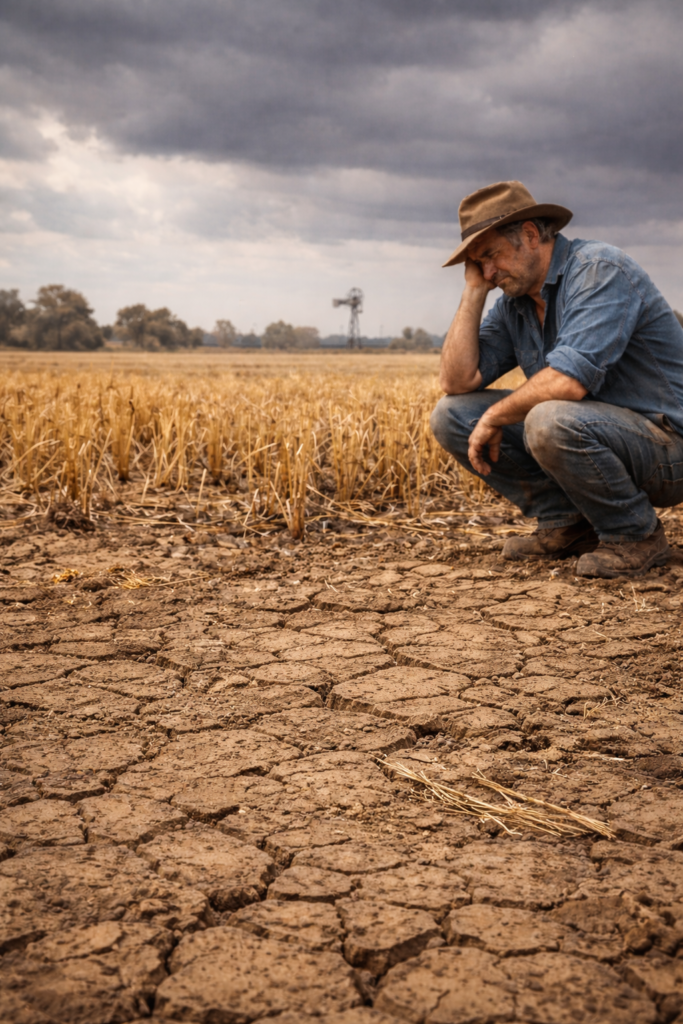
The rainfall picture is what makes the story more complicated than a simple national drought headline. Some southern growers have had useful rain. ABC Rural reported on 8 April that parts of South Australia had received record March rain, encouraging some farmers to plant canola and other winter crops weeks earlier than usual. But the same report also said those growers were effectively rolling the dice, because they were planting into a dry-leaning outlook while also worrying about soaring diesel and fertiliser costs.
Further north and east, the moisture story is less encouraging. The Bureau of Meteorology says March root-zone soil moisture was below to very much below average across north-eastern New South Wales into south-eastern Queensland, and that those deficits expanded and intensified during March. ABARES added on 9 April that only low rainfall totals of 0 to 10 millimetres were forecast over the following week for southern Queensland and northern New South Wales, at the same time as the broader seasonal outlook leaned below median across much of eastern Australia.
That is why “no rain” is not just shorthand for a poor forecast. In many districts it means growers do not have the subsoil moisture buffer needed to justify an aggressive winter program, especially one built around expensive nitrogen. Grain Central reported that much of New South Wales north and west of the south-west slopes remained dry, that outer western Downs country also had limited subsoil moisture, and that growers across NSW and into Queensland were hoping for solid rain by May to start winter cropping on time. Without it, they could switch toward more grazing, summer crops later on, or lower-input winter options.
Southern optimism and northern hesitation are colliding
One of the most interesting features of this season is that growers are not all facing the same decision. In parts of South Australia, the major question has been whether to plant early and make use of unexpected subsoil moisture. Grain Central reported on 8 April that some growers were asking whether they should sow early, whether they should use a different crop or variety, and whether they should switch to a lower-input crop, all while balancing germination, flowering windows, frost risk, and concerns about fuel and fertiliser pricing and supply.
In the north, the question is often more basic: does a winter crop stack up at all? Grain Central’s 2 April market report quoted northern trade sources saying there was an “enormous amount of discretionary area” that was dry, and that because of the cost of diesel and urea, growers were holding stock on farm and staying reluctant to commit. It also said new-crop trade remained illiquid because uncertainty was not only about the season, but also about input and fuel pricing.
High input costs are reshaping crop choice
This is where the triple squeeze turns from a headline into a paddock-level management problem. It is not only affecting how much gets planted; it is also affecting what gets planted. ABC Rural’s South Australian reporting said canola and wheat budgets were being hit hard because those crops “really need” urea, with one Eyre Peninsula grower expecting fuel and fertiliser to push his budget up by at least $180,000. Grain Central also reported growers actively asking whether they should move toward lower-input crops, or use products and strategies that reduce reliance on synthetic nitrogen.
That does not mean rotations are being torn up everywhere. Some growers will still stick largely to established plans. But the season is clearly pushing more businesses into risk-management mode. Where moisture is there, some may still back canola or wheat. Where moisture is thin and nitrogen is expensive, lower-input crops, trimmed fertiliser rates or reduced planted area become easier to justify. In that environment, the winter-crop program becomes less about chasing the highest upside and more about surviving the downside.
The triple squeeze is also feeding market volatility
Another underappreciated part of the story is what this uncertainty does to the grain market itself. When growers are unsure whether they will plant, unsure what input costs will look like, and unsure whether long-haul freight can be priced with confidence, trade becomes nervous. Grain Central said buyers were struggling to commit because freight rates were unstable, while sellers were often reluctant to price grain too far ahead because the whole production and input-cost picture remained unsettled. The result has been a market that is reactive, thin and jumpy rather than confident and deep.
That matters because winter-crop decisions are never made only on agronomy. Growers also watch whether grain values compensate for the risk. But a shaky market does not always give clean signals. It can instead reinforce caution, especially when the seasonal picture is already poor. This is one reason 2026 feels like a year where many businesses will prefer optionality over commitment for as long as they can get away with it.
What many growers are really deciding now
In practical terms, the current decision is not simply “plant” or “do not plant”. It is often one of several harder questions. Do we go early where moisture exists, knowing frost and dry-finish risk are real? Do we cut back higher-input crops and protect cash? Do we sow a lower-input program and accept lower upside? Do we hold off and see whether May brings proper follow-up rain? Grain Central’s recent coverage and GrainGrowers’ public warnings both point to exactly this kind of decision tree playing out across the grainbelt.
And that is what makes the current season so uncomfortable. Growers are not being asked to make one big decision with one big risk attached. They are being asked to balance multiple moving parts at once: dry profiles in some regions, dearer diesel, uncertain urea, volatile freight, and a weather outlook that is offering more caution than comfort. That is a far harder setting in which to commit millions of dollars’ worth of crop inputs.
Final word
The phrase “fuel, fertiliser and no rain” captures the mood of the season because each of those problems would be serious on its own. Together, they are forcing a much more conservative and anxious start to winter cropping than many growers had hoped for after recent rains in parts of the south. The issue is not that every district is dry, or that every grower will pull back. It is that enough of the grainbelt is dry, enough of the input chain is shaky, and enough of the economics are under pressure to make 2026 a genuinely hard season to read.