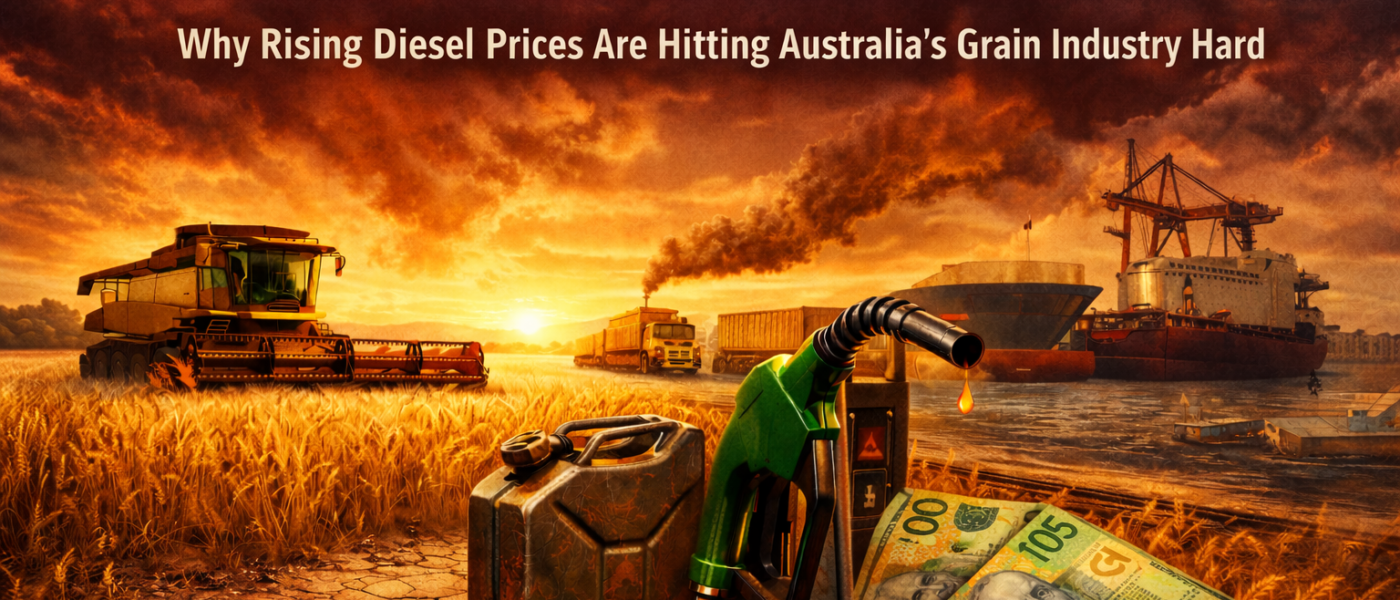

There are few things in Australian agriculture more fundamental than diesel. It is not glamorous, and it rarely gets the romance that rain, harvest or grain prices do. But when diesel jumps hard in price — and gets patchy in regional availability at the same time — it sends a tremor through the whole grain chain, from the first paddock pass to the final load heading for port. Right now, that is exactly what is happening: official messaging says Australia is not facing a nationwide fuel collapse, but regional supply stress is real, panic buying has distorted normal distribution, and diesel prices have moved sharply higher in a matter of days.
The rise in price alone is enough to rattle growers. ABC reporting based on Australian Institute of Petroleum data says the national average diesel price rose 15.6 cents in a week to 196.5 cents a litre by 8 March. The Australian Trucking Association said the market price for diesel had surged from A$130 to almost A$220 per barrel between 27 February and 6 March, with retail diesel up almost 19 cents per litre since the previous Sunday. That is not a small adjustment. That is a cost shock.
And grain is especially exposed because diesel is stitched into every stage of the business. GrainGrowers says Australia’s grain industry needs a secure, reliable and affordable liquid fuel supply to underpin production and supply chains. The same organisation notes that freight costs account for 30 per cent of the price of grain at port, which is a striking reminder that fuel pain does not stop at the farm boundary. It rolls all the way through to marketing, handling and export competitiveness.
That is what makes this more than a bowser story. In grain country, diesel runs tractors, seeders, sprayers, headers, chaser bins, telehandlers, augers, generators and the trucks that move grain between farm, depot, railhead, mill, feedlot and port. The federal government’s own fuel-security framework explicitly says diesel is Australia’s most critical fuel in a shortage or emergency scenario, with direct importance to transport, mining and agriculture.
What is unsettling growers is that this is landing at a time when the grain sector is already carrying a huge task. ABARES says growers have just delivered the second largest winter crop on record, and its March commodities outlook says national winter crop production in 2025–26 is expected to be the second highest on record. In plain terms, there is a lot of grain in the system, and moving, storing and selling large crops always depends on affordable logistics. When fuel costs spike against that backdrop, the pressure multiplies.
The official line from Canberra is that Australia still has fuel coming in and that the immediate issue is not a national lack of supply, but demand surges and distribution strain. Chris Bowen said on 3 March that Australia had 34 days of diesel on hand if supplies were to stop entirely, while ABC separately reported the strategic reserve at 32 days of diesel as of the same period. The government’s minimum stockholding rules also require baseline diesel stocks of 20 days for refiners and 32 days for importers. So this is not a case of the nation being bone dry. But for a grower waiting on a farm delivery, the distinction between “not enough fuel in the country” and “fuel not getting to the right place” can feel academic.
That is particularly true in regional Australia, where distance always magnifies stress in the system. The Guardian reported that demand has doubled and even tripled in places such as the Barossa and Mildura, while some regional distributors said they were receiving only about 10 per cent of their usual allocations. The same report said independent country outlets can be especially vulnerable because they may not have the same firm contractual arrangements as larger branded sites. In a grain-growing district, that matters enormously: once local access tightens, every extra kilometre to find fuel becomes another cost and another delay.
The on-farm effect can be immediate. Grain market reporting on 10 March said growers were already nervous about the pricing and availability of diesel for winter-crop planting, which will begin in earnest next month. The report also said uncertainty around fuel prices was already stymieing trade and affecting freight thinking. This is the sort of disruption the grain industry hates most — not simply high prices, but uncertainty at the very moment operational decisions are being made.
Then there is the freight leg, where “from paddock to port” becomes more than a headline. Traders told Grain Central that price hikes visible at diesel bowsers suggested 10 per cent could be added to the benchmark long-haul grain freight rate, then sitting at an indicative $35 a tonne for a 300-kilometre run into Brisbane. If that kind of uplift sticks, it starts altering cash bids, basis, storage decisions and selling behaviour. Grain that looked marketable at one freight rate can suddenly look a lot less attractive when road costs jump.
The trucking sector itself is hardly in a position to absorb the blow. ABC reported on 10 March that road transport — the industry that moves “everything you buy in shops” — had already seen one in 12 businesses close in 2025, according to CreditorWatch. The same report quotes the Australian Trucking Association saying fuel is typically one of the top three costs for a trucking business. In other words, grain is leaning on a freight network that was already financially stretched before diesel lurched higher again.
Once the grain reaches the port end of the chain, the cost pressure does not magically disappear. The Container Transport Alliance of Australia warned on 10 March that operators should review fuel surcharge rates at least weekly as terminal gate prices soar. For containerised grain and pulse movements, or for any export leg dependent on container transport, that is another signal that fuel volatility is now working its way through the logistics stack, not just sitting at the service station sign.
This is why diesel shocks hit grain-growing regions so hard. Grain farming is a margin business, a timing business and a distance business all at once. Every extra cent per litre touches machinery, every freight surcharge touches market returns, and every delay in fuel access threatens the narrow windows in which paddock work has to happen. In mixed-farming districts, it can even influence enterprise preference: reporting this week suggested added concern over diesel and urea costs was making livestock look more attractive relative to cropping for some producers. That is how a fuel story can start nudging actual production decisions.
There is also a broader regional story here. Grain-growing communities are not just paddocks and silos; they are local carriers, mechanics, bulk handlers, fuel depots, machinery dealers, container yards and country towns whose spending rhythm follows the agricultural cycle. When diesel becomes dearer or harder to access, the pain does not stay with the grower alone. It leaks into freight margins, contractor rates, input decisions, cashflow timing and local business confidence. GrainGrowers’ point about freight making up 30 per cent of the price of grain at port is really another way of saying this: energy cost is already deeply embedded in the economics of regional Australia.
So where does that leave the industry? Probably somewhere between concern and adaptation. If prices settle and supply stress eases, growers and carriers will wear this as another nasty burst of volatility in an already volatile business. But if higher diesel prices persist into planting and then beyond, the consequences will travel well beyond the farm gate. They will show up in haulage invoices, in grain marketing decisions, in export competitiveness, in regional business costs and, eventually, in the price paid by end users further down the food chain. The point is not that diesel is the only story in grain. It is that without it, none of the other stories move.