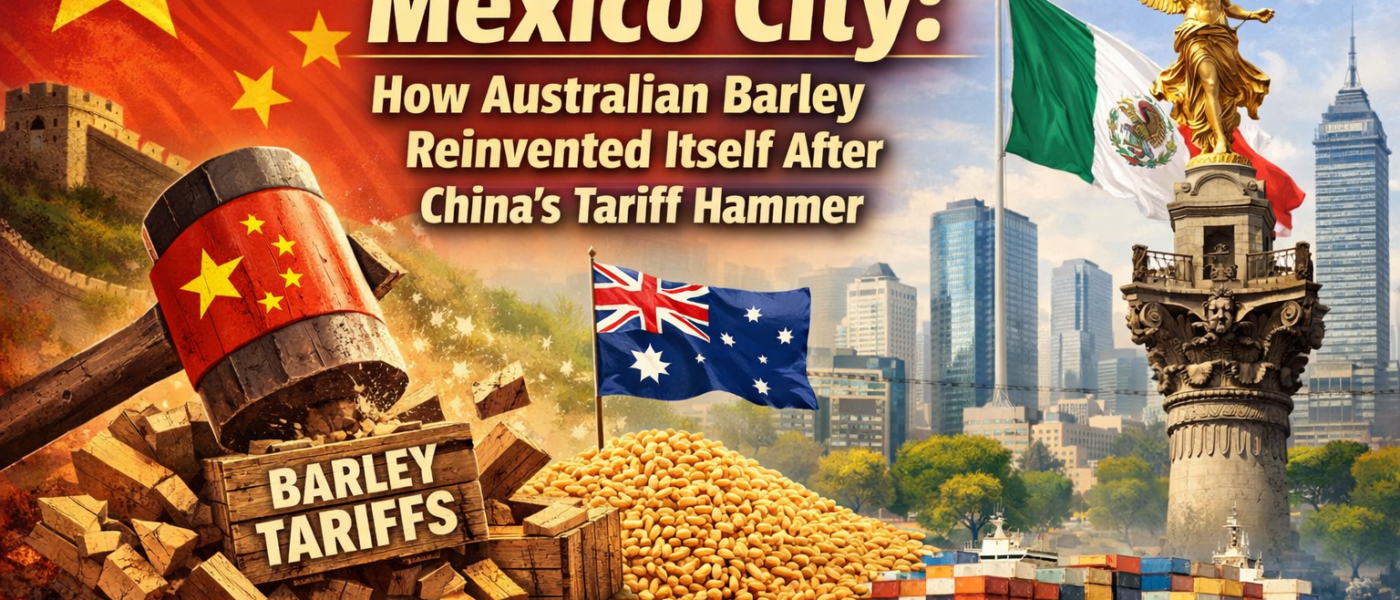

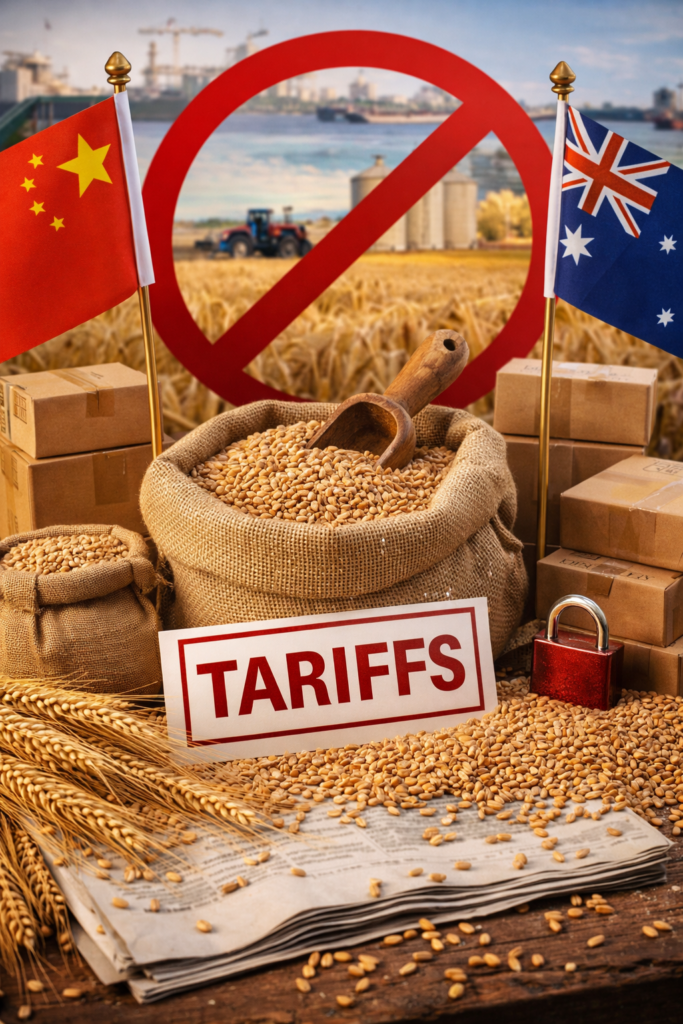
In May 2020, the Australian barley industry woke up to a nightmare. China—the destination for more than half of the country’s barley exports, a market worth roughly $1.2 billion a year—slammed the door shut with an 80.5 per cent tariff. The official justification was anti-dumping and countervailing duties. The unofficial consensus was geopolitical retaliation, payback for Canberra’s push for an international inquiry into the origins of COVID-19.
Overnight, Australian barley became uncompetitive in the world’s hungriest feed grain market. Exports to China collapsed from 6.5 million tonnes to virtually nothing. Prices tanked. Growers stared down the barrel of an estimated $2.5 billion hit over five years.
But here’s the thing about Australian grain farmers: they don’t sit still for long. What followed was one of the most impressive trade pivots in Australian agricultural history—a scramble across continents that ended up landing barley in beer glasses from Monterrey to Riyadh. And now, with the tariffs gone and China buying harder than ever, the industry faces a different kind of question: did it actually learn the lesson?
The $1.2 Billion Hole
To understand how deep the wound ran, you need to appreciate how dominant China was in Australia’s barley trade. Before the tariffs, China took about 58 per cent of all Australian barley exports. It wasn’t just the volume—it was the premium. Chinese buyers paid top dollar for Australian product, which was prized for both feed and brewing applications. The relationship stretched back decades, supported by technical cooperation in plant breeding and quality assurance.
When the 80.5 per cent duty landed—comprising a 73.6 per cent anti-dumping tariff and a 6.9 per cent countervailing duty—it didn’t just reduce trade. It killed it. The tariff made Australian barley so expensive in China that importers simply stopped picking up the phone.
The Grains Research and Development Corporation estimated the cost to the industry at roughly $500 million per year. That pain rippled straight to the farm gate. Barley prices collapsed, and growers across Western Australia, South Australia and Victoria found themselves sitting on grain they could no longer sell at anything close to a worthwhile return. Some pivoted to canola and milling wheat. Others held their nerve.
The Great Pivot: Saudi, Mexico, and Beyond
The industry’s response was swift, if not painless. The first and most obvious move was to Saudi Arabia, the world’s largest buyer of feed barley at around 2.5 million tonnes a year. Australian barley had always had a presence in the Kingdom, but with China gone, the Middle East became the new centre of gravity. By 2021, Saudi Arabia had climbed to become the number one destination for Australian feed barley exports, accounting for about 35 per cent of shipments.
But the real headline-grabber was Mexico. In early 2021, Western Australia’s CBH Group—the cooperative representing more than 3,500 grain growers—signed a deal to ship 30,000 tonnes of malting barley to Heineken Mexico. It was a first. Australian barley had never been a meaningful player in the Latin American brewing market, but necessity is a powerful matchmaker.
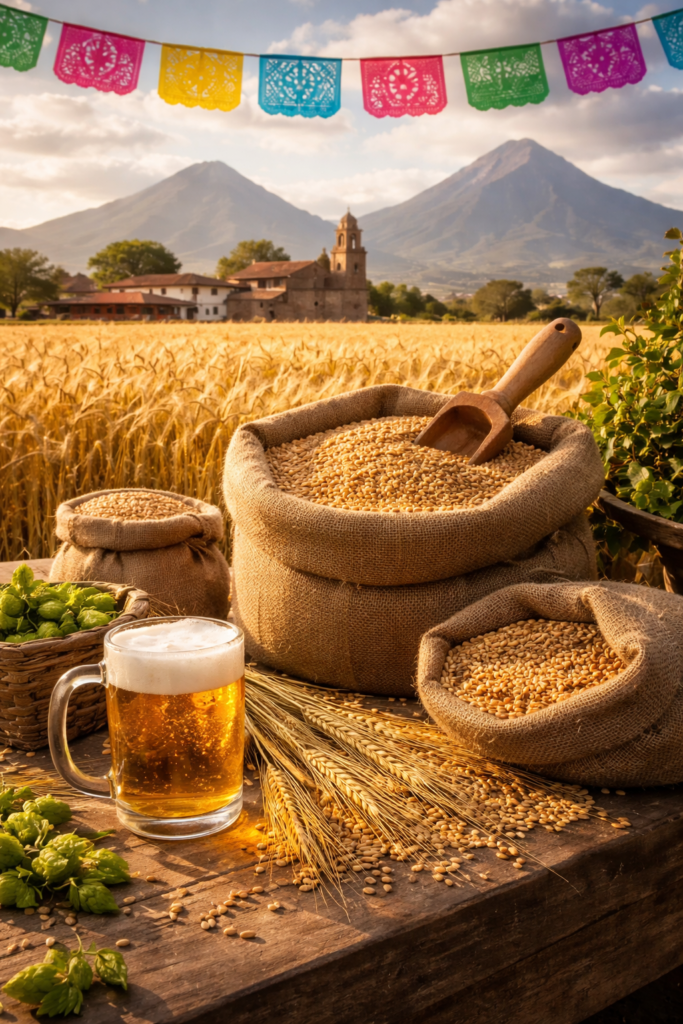
The Mexico trade didn’t just stick—it exploded. By 2022, Australia accounted for a staggering 95 per cent of Mexico’s barley imports, valued at $145 million. By late 2025, Mexico was importing up to 300,000 tonnes of Australian malt barley a year, representing more than 60 per cent of the country’s total barley import needs of 400,000 to 500,000 tonnes. That’s a remarkable result, especially considering Mexico sits next door to two of the world’s biggest barley producers in the United States and Canada, with a significant freight advantage over Australia.
The secret? Quality. Australian malting barley varieties performed exceptionally well in trials for the big brewers. Low moisture content, reliable supply, and Australia’s reputation for clean grain gave it an edge that cheaper freight alone couldn’t match. The Trans-Pacific Partnership trade agreement also helped, lowering tariff barriers that had previously exceeded 100 per cent.
And Mexico was only the beginning. The Australian Export Grains Innovation Centre led trade missions across Latin America, visiting brewers and maltsters in Chile, Colombia, Brazil, Ecuador, and Peru. Colombia, where beer accounts for nearly 90 per cent of all alcohol consumed and AB InBev controls 99 per cent of the market, was flagged as a particularly promising frontier. Meanwhile, traditional markets like Japan, Thailand and Vietnam continued to absorb solid volumes.
As GrainGrowers’ Sean Cole put it at the time, China had done the industry a favour by forcing it to lift its eyes to new opportunities. Not everyone agreed with that sunny framing—the industry was still losing an estimated $30 to $50 per tonne on redirected grain compared to the China premium—but the diversification was real and it was working.
The Door Reopens
On 5 August 2023, China’s Ministry of Commerce announced it was removing the tariffs, declaring them no longer necessary in view of changes in the Chinese barley market. The diplomatic thaw that had begun with the Albanese Government’s more measured approach to Beijing was bearing fruit. Australia discontinued its WTO case, and shipments resumed almost immediately.
The recovery was swift. CBH Group shipped two vessels to China within the first two months. By the end of 2023, China had imported 314,000 tonnes of Australian barley worth $139 million since the tariff was lifted. Through 2024, the trade roared back further, with exports to China reaching $1.22 billion for the calendar year according to UN COMTRADE data.
By 2025, the snapback was complete—and then some. China took just over 6 million tonnes of Australian barley, dwarfing all other destinations combined. Japan, the second-largest buyer, received under 600,000 tonnes. China was back to accounting for roughly 70 to 75 per cent of total Australian barley exports.
Record Crop, Old Habits
Here’s where the story gets complicated. The 2025–26 season has delivered a record Australian barley crop—ABARES forecasts production at 15.7 million tonnes, 33 per cent above the 10-year average. Exports are tipped to hit 8.6 million tonnes, the second highest on record. In December 2025 alone, Australia shipped 1.22 million tonnes, the biggest single month since late 2023. China took 80 per cent of the feed barley and the lion’s share of malting shipments.
The numbers are extraordinary. But the concentration risk is staring the industry in the face, and not everyone is comfortable with what they see.
The analysts at Episode 3, an Australian grain market advisory, put it bluntly in early 2026: Australia’s barley sector is now far more exposed to changes in Chinese import demand, policy, or substitution than its wheat or canola sectors. The level of concentration on a single buyer is greater than at any point in the pre-tariff era.
Meanwhile, Rabobank flagged that Chinese authorities have been encouraging local traders to prioritise domestic grain purchases as the country’s own inventories grow and consumer confidence weakens. The implication is clear: the flow of barley to China could slow at any time, not because of tariffs this time, but because of softening demand.
And those new markets the industry worked so hard to open? Some of them have already been displaced. The USDA’s Foreign Agricultural Service noted in January 2026 that strong Chinese demand had pushed aside several traditional markets, particularly Japan, Saudi Arabia and Vietnam, which had been absorbing significant volumes of Australian barley during the tariff years. Mexico and Latin America remain important, but they too have seen their share shrink as ships turn back toward Chinese ports.
The Middle East Wildcard
As if the China concentration debate weren’t enough, the escalation of conflict in the Middle East from late February 2026 has thrown yet another variable into the mix. The Strait of Hormuz—through which a significant share of global energy and fertiliser trade passes—has been disrupted by the US-Israel-Iran conflict, triggering shipping diversions, emergency surcharges, and growing anxiety about fuel and fertiliser supplies ahead of the Australian winter cropping season.
For barley growers specifically, the Middle East disruption cuts two ways. The region is a direct export destination for Australian feed barley, particularly Saudi Arabia, Kuwait and the UAE. Disrupted shipping lanes mean higher costs and uncertain delivery timelines. At the same time, the conflict is pushing up diesel prices and threatening fertiliser supply chains—Australia sources an estimated 68 per cent of its urea imports from the Middle East. If the conflict extends beyond a few weeks, input costs for the 2026 crop could climb significantly.
The Freight and Trade Alliance warned in early March that the situation was already having measurable impacts on Australian supply chains, with conflict-related surcharges from major carriers adding material costs for exporters. Fertiliser industry leaders said most product needed for the imminent autumn seeding was already in Australia or in transit, but the real pressure point would come between late April and early May if Gulf supply remained disrupted.
The Lesson That Keeps Teaching Itself
The Australian barley story is, at its heart, a parable about trade concentration—one that the industry has now lived through twice in the space of six years.
The first time around, when China’s tariff hammer fell, the industry proved remarkably resilient. It found Saudi Arabia. It found Mexico and Heineken. It found brewing prospects in Colombia and Chile. It showed that Australian barley could compete on quality even when freight economics said otherwise. Grain Producers Australia, the National Farmers’ Federation, and trade bodies like AEGIC all pointed to the diversification as proof that the industry could adapt.
But the gravitational pull of China is immense. When the tariffs came off, the market snapped back with startling speed. The premium prices, the established relationships, the sheer scale of Chinese demand—it all reasserted itself. And now, with a record crop to move and China buying aggressively, the comfortable path and the risky path look like exactly the same road.
None of this is lost on industry leaders. The conversations at the 2026 GRDC Updates, at GrainGrowers board tables, and in the corridors of Grain Trade Australia are all shaded by the same uneasy awareness: the next disruption might not be a tariff. It could be a shift in Chinese domestic policy, a global shipping crisis, or a geopolitical shock that nobody saw coming. The Middle East conflict is a live reminder that the world doesn’t wait for the grain industry to get its diversification strategy sorted.
The real challenge isn’t finding new markets—the tariff years proved Australia can do that. The real challenge is keeping them warm when China is paying top dollar and buying every tonne in sight. That’s the tension at the heart of Australian barley in 2026: a record crop, a booming trade, and a nagging sense that the industry has been here before.
As one veteran grain trader observed during the tariff years, the best time to find new customers is when you don’t desperately need them. Right now, with Chinese demand surging and the crop bins overflowing, Australia’s barley growers don’t desperately need new customers at all. Which might be exactly why this is the best time to go looking.