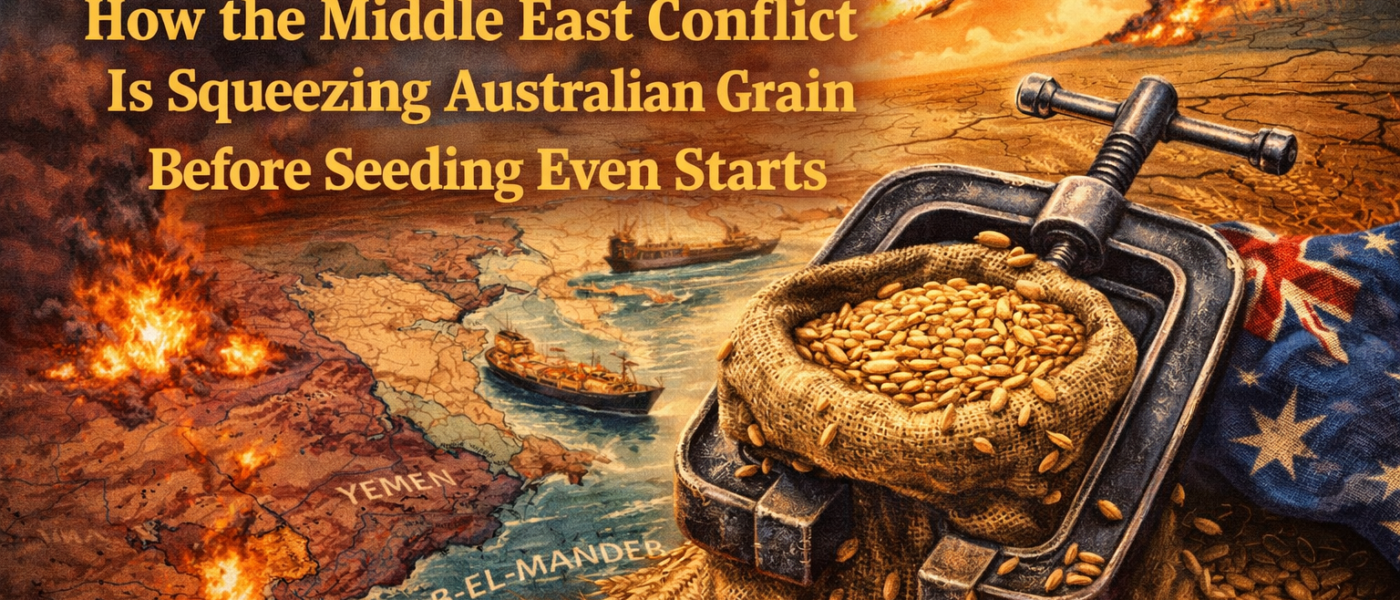

The Bab el-Mandeb Strait—the Gate of Tears, in Arabic—has been causing headaches for maritime trade since antiquity. But it’s the Strait of Hormuz, 2,500 kilometres to the east, that is now tearing through Australian agriculture’s carefully laid plans for 2026. Since the United States and Israel launched coordinated strikes on Iranian targets on 28 February, the narrow waterway through which roughly a fifth of the world’s seaborne oil and a staggering share of global fertiliser exports normally flows has been effectively shut down.
For Australian grain growers, the timing could hardly be worse. Autumn seeding is weeks away. Diesel tanks need filling. Fertiliser sheds need stocking. And the two inputs that underpin every winter cropping program in the country—fuel and nitrogen—are now caught in the crossfire of a conflict playing out on the other side of the Indian Ocean.
This is a story about how a war that most Australians are watching on their phones is already changing the maths on their farms.
The Fertiliser Crunch
Australia has no domestic urea production to speak of. None. Every granule of the nitrogen fertiliser that underpins cereal and canola yields arrives by ship, and roughly 69 per cent of it has been coming from the Middle East—primarily Qatar, Saudi Arabia, the UAE, Oman and Bahrain. In 2025, Australia imported more than 60 per cent of its urea from the Gulf region, with the remainder sourced mostly from Southeast Asia.
The closure of the Strait of Hormuz has not merely disrupted this trade—it has, for practical purposes, stopped it. Shipowners have pulled vessels from the region. War risk insurance premiums have surged. Major carriers including Maersk, MSC and CMA CGM rerouted ships via the Cape of Good Hope, adding at least 14 days to voyage times. Nearly a million metric tonnes of fertiliser cargo is now physically stranded in the Gulf, with producers declaring force majeure.
The price response has been savage. Global urea prices have surged roughly 50 per cent since the first airstrikes, jumping from around $482 per tonne FOB Egypt in late February to $720 per tonne by mid-March. In Australia, the Episode 3 market advisory reported model prices leaping from around $872 per tonne in late February to over $1,200 per tonne—with some sources quoting $1,300. And those are prices for product that may or may not actually be available.
The arithmetic of Australia’s urea import program reveals just how vulnerable the timing is. On average, only about 16 per cent of the country’s annual urea imports have arrived by the end of March. The real volume lands between April and June, when cumulative imports typically climb from 28 per cent to 62 per cent of the annual total. That April-to-June window is exactly when winter crop planting kicks into gear. Episode 3’s analysts were blunt: the real pressure point sits between late April and early May. Beyond that, shipping lead times collide with application schedules. If Gulf supply hasn’t resumed by then, physical shortages become a genuine possibility.
It’s not just urea. The conflict has also disrupted sulphur exports—the Middle East supplies roughly 44 per cent of global sulphur, an essential feedstock for phosphate fertilisers like MAP and DAP. Qatar was forced to halt production at one of the world’s largest urea plants following strikes on energy infrastructure. Even countries distant from the conflict zone are feeling the ripple: Bangladesh has shut five of its six urea plants due to gas shortages, and European producers are trimming output as gas prices climb.
What Growers Are Doing Right Now
On the ground, the response has been a mix of pragmatism, anxiety and rapid recalculation. Growers who locked in early fertiliser supply contracts are in a strong position. Grain Producers Australia chair and WA grower Barry Large told Grain Central he had ordered early and was covered for planting. But as he acknowledged, that doesn’t help everyone else.
WA-based supplier Summit Fertilizers reported it had enough stock in Australia or in transit to meet all existing orders for seeding phosphates and existing nitrogen contracts. But it could not guarantee further nitrogen supply beyond those commitments and cautioned that unpriced products remain exposed to international price swings. CSBP, another major WA supplier, said it could guarantee supply for all seeding phosphates and existing fixed contracts for its Flexi-N liquid nitrogen product, but offered no assurances for growers without pre-existing arrangements.
For those caught without cover, the options are shrinking fast. Some growers are exploring alternatives—sulphate of ammonia instead of urea, or different fertiliser blends—to get crops in the ground even if their preferred nitrogen product is unavailable. Others are contemplating a more drastic response: planting fewer hectares, concentrating inputs on their best paddocks and leaving the rest fallow.
GIWA crop report author Michael Lamond told Grain Central that even before the conflict, barley was poised to take area from wheat in WA based on stronger gross margins. Now, with urea prices elevated and availability uncertain, the crop mix calculus has shifted further. Barley is an earlier-maturing crop that can be managed differently to wheat—and canola, while the most profitable option in recent years, has the highest nitrogen demand. If urea stays scarce and expensive, WA’s record canola area from 2025 is unlikely to be repeated.
As Lamond put it: what could happen in WA is there’ll just be less crop.
The Diesel Squeeze
If fertiliser is the slow-burning crisis, fuel is the one farmers can feel immediately at the bowser. Australia entered this conflict with roughly 34 to 36 days of fuel reserves—the highest level in 15 years, but still well below the International Energy Agency’s recommended 90-day benchmark. The country imports more than 70 per cent of its refined fuel, much of it processed at Asian refineries from Middle Eastern crude.
Diesel prices have climbed sharply. Retail prices in many regional centres jumped from around 175 cents per litre before the conflict to over 225 cents by mid-March, with regional variation making the picture worse in remote agricultural areas. Western Australia, where Perth prices hit $2.37 per litre, has been particularly affected. Some regional service stations in WA towns like Kulin and Corrigin—the heart of the grainbelt—introduced temporary fuel restrictions due to uncertain deliveries and surging demand.
The National Farmers’ Federation president Hamish McIntyre warned that without fuel and fertiliser, farmers simply cannot get food and fibre to consumers. NSW Farmers’ grains committee chairman Justin Everitt reported bulk fuel orders in the Riverina being partially filled or not supplied at all. NSW Farmers president Xavier Martin said farmers across the country were running out or running low, with independent rural distributors telling members they were dry.
The government authorised the release of up to 762 million litres of petrol and diesel from domestic reserves and temporarily lowered fuel quality standards for 60 days to allow higher-sulphur fuel onto the market. Energy Minister Chris Bowen ruled out rationing, but the messaging from every level of government amounted to the same plea: don’t panic buy, and don’t fill jerry cans.
For grain growers, the concern isn’t a weekend road trip—it’s the thousands of litres needed daily to run headers, tractors, trucks and spray rigs through a seeding program that waits for nobody. Agriculture runs on diesel. Without it, tractors stop, irrigation stops, harvest stops and food stops moving.
Shipping and the Cost of Getting Grain Out
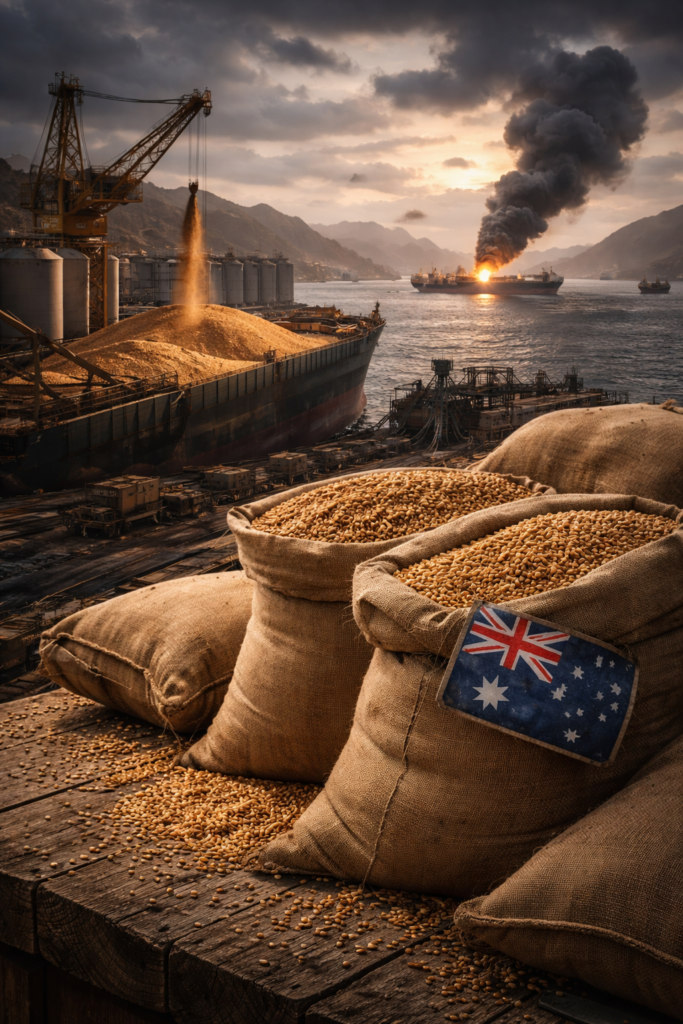
The conflict isn’t just squeezing inputs coming in—it’s also raising the cost of getting grain out. The Freight and Trade Alliance and Australian Peak Shippers Association warned in early March that the situation was already having measurable impacts on Australian supply chains, with emergency conflict surcharges imposed at short notice by major international carriers.
The Middle East itself is a direct export destination for Australian grain, particularly feed barley to Saudi Arabia, Kuwait and the UAE. Disrupted shipping lanes mean higher costs, longer transit times and uncertain delivery windows for these markets. MSC, the world’s largest shipping line, declared an end of voyage for all shipments under its custody destined for Arabian Gulf ports—an unprecedented move affecting an estimated 350,000 containers globally. A mandatory deviation surcharge of $800 per container was imposed.
For the Australian grain trade, the broader concern is the cascading effect on global freight rates and insurance costs. War risk surcharges, rerouting via the Cape of Good Hope, and the collapse of Gulf hub operations all add cost layers that ultimately compress farm gate returns. When it costs more to move a tonne of barley to Riyadh, the price the grower receives at the silo goes down, not up.
The irony is palpable. Australia just produced a record national barley crop and near-record wheat crop. The bins are full, the export program is in full swing, and there has never been more grain to sell. But the global logistics system through which that grain must travel is being reconfigured in real time by events that no crop budget accounted for.
The Bigger Picture: Structural Vulnerability
The Middle East crisis has exposed a vulnerability that agricultural economists and supply chain analysts have been warning about for years. Australia is the only major grain-exporting nation with effectively zero domestic nitrogen fertiliser production. The Perdaman Urea Project in WA, which would produce over two million tonnes annually and go some way to addressing this gap, is still years from operation.
Until something like Perdaman comes online, Australia’s cropping sector remains structurally dependent on a just-in-time fertiliser supply chain that stretches through the world’s most geopolitically volatile maritime corridor. The same goes for fuel. With just two domestic refineries—Ampol’s Lytton in Brisbane and Viva Energy’s Geelong plant—processing less than 30 per cent of national needs, Australia imports its way through every planting and harvest season.
The World Economic Forum’s analysis of the current crisis noted that Australia depends on the UAE, Qatar and Saudi Arabia for more than half its urea. The disruption draws direct comparisons to the fertiliser price shock triggered by Russia’s invasion of Ukraine in 2022, which sent urea prices spiralling and forced growers worldwide to reassess their input budgets. Some analysts have argued the current situation is worse, because the Hormuz closure affects not just one product but the entire web of energy and chemical supply chains that fertiliser production depends on.
Research has shown that in previous fertiliser price spikes, Australian growers have been able to absorb increased input costs without dramatically reducing production or passing costs through to consumers. Weather, not fertiliser prices, remains the dominant driver of yield variability. But that analysis assumed the fertiliser was available to buy at any price. The current crisis raises a different question: what happens when you simply can’t get it?
The Weeks Ahead
As March draws to a close, the Australian grain industry finds itself in an uncomfortable holding pattern. Fertiliser Australia’s chief executive Stephen Annells said in early March that most product required for the initial seeding window was either in Australia or safely in transit. But that assurance covered the opening weeks of planting, not the top-dressing requirements that come later in the growing season—and it was made before the full scale of the disruption became clear.
The critical window is now. If Hormuz shipping resumes within the next month and production facilities restart, the supply chain can probably muddle through with higher costs but adequate volumes. If the conflict drags on through April and into May, Australia faces the prospect of genuine nitrogen shortages during peak application season. Growers will make do—they always do, by adjusting rates, switching products, concentrating on their best country. But there will be a cost, measured in lower yields, tighter margins and a smaller national crop than the season might otherwise have delivered.
GIWA’s initial estimate for WA’s 2026–27 winter crop is due next month, and nobody expects it to match last year’s record. Even before the bombs started falling, softer grain prices and tighter budgets were pointing to a smaller program. The Middle East conflict has added a layer of uncertainty that makes planning extraordinarily difficult.
Australian grain growers are accustomed to managing risk. Drought, frost, price volatility, trade disputes—these are the occupational hazards of farming in one of the most variable climates on Earth. But a war shutting down the strait through which your fertiliser and fuel arrive? That’s a risk most farm budgets never contemplated.
The Gate of Tears has earned its name again. For Australian grain, the question now is how long the tears last—and how much they cost.