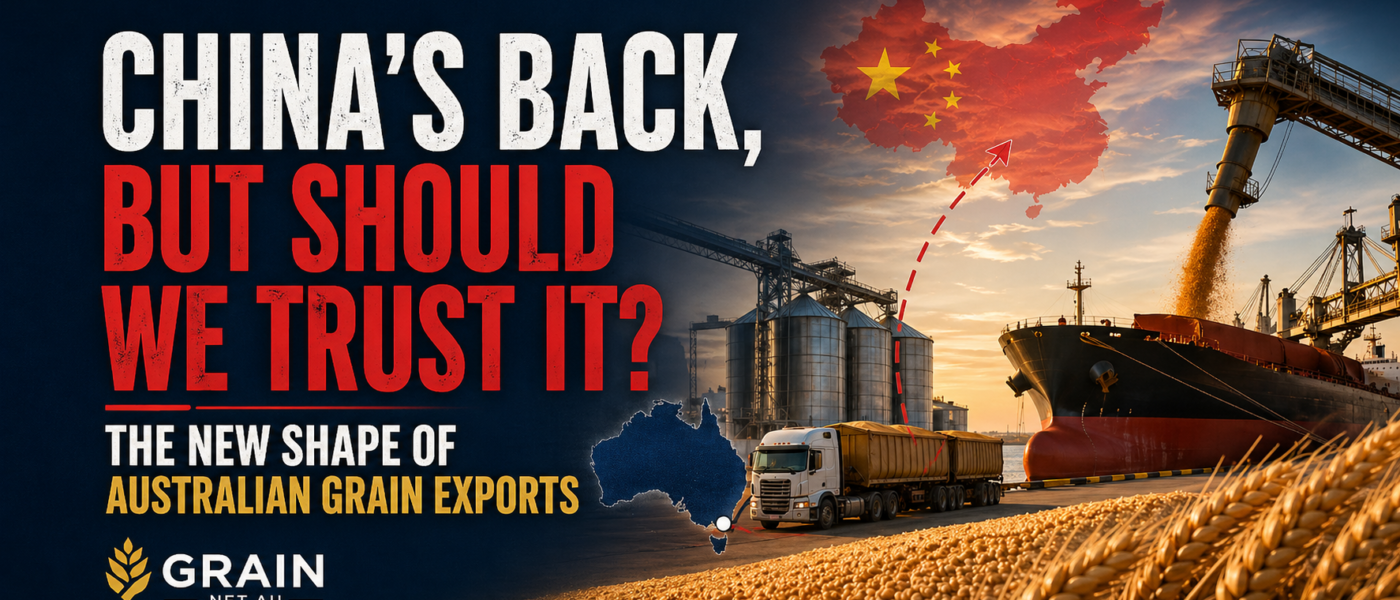

Here’s a number that should give the grain industry pause. In 2025, China bought just over 6.0 million tonnes of Australian barley — more than ten times as much as the next-largest destination, Japan. That single buyer accounted for roughly three-quarters of our entire barley export program.
If that stat feels vaguely familiar, it should. It’s almost exactly where we were in 2019, right before China hit us with an 80.5% tariff and shut the door for three years. The diplomatic relationship has thawed, the tariffs have gone, and the trade has snapped back with remarkable speed. The question nobody in the industry seems to want to ask out loud is whether the lessons of 2020-2023 have actually been learned — or whether we’ve simply rebuilt the same dependency with different rhetoric around it.
The honest answer is: it depends which crop you’re talking about.
A quick recap, for anyone who was in a coma between 2020 and 2023
Between 2020 and 2023, China imposed tariffs and informal bans on a range of Australian exports including barley, wine, beef, timber, coal, cotton, and lobster. Most restrictions were removed as part of a diplomatic reset that began in late 2022. The barley trade essentially went to zero for three years. Growers pivoted hard into Saudi Arabia, Vietnam, Japan, and anywhere else that would take a shipload. Wheat exports to China continued (it wasn’t targeted), and chickpeas to India boomed after New Delhi temporarily waived its tariff in late 2021.
For a while, the narrative was that Australia had toughened up. Diversification became the buzzword. Industry bodies talked about “resilience” and “lessons learned”. And then the tariffs came off, the market reopened, and behaviour reverted to the mean faster than anyone wanted to admit.
Wheat: actually diversified, and that’s a genuine achievement
Let’s start with the good news, because there is some. Wheat has quietly become Australia’s diversification success story.
Total shipments in 2025 came in at just over 24 million tonnes — a strong overall year that reinforces Australia’s position as a major global supplier. Demand is heavily concentrated in Asia, with Indonesia the dominant destination, followed by the Philippines, Vietnam, Thailand, Malaysia, Japan and South Korea. China, however, stands out as a notable exception in 2025 — exports fell to just over one million tonnes, a sharp decline from recent peaks above six million tonnes in 2022 and 2023, and well below the 2024 level of more than three million tonnes.
Go back to 2022-23, and China took 7.59 million tonnes, or 23.9% of the total wheat program. In 2024-25, the 1.05 million tonnes shipped to China put it eighth on the list, with just 4.5% of the total wheat program.
The reason for the collapse isn’t diplomatic. It’s structural. Peter Simonaitis at Grains Australia recently spelled out what’s happening: China’s government grain reserves have grown from 85 million tonnes in 2020 and are now close to their 125 million tonne capacity, sitting at about 123.5 million tonnes. They’re effectively full. When your strategic buyer has nowhere left to put the grain, it doesn’t matter how cheap the freight is.
What’s filled the gap is more interesting. Indonesia is now Australia’s biggest bulk wheat destination on 3.96 million tonnes, with Vietnam the fourth-biggest on 1.37 million tonnes of bulk wheat plus 240,000 tonnes of containers. Vietnam in particular has become the quality bread market Australia always wanted — a consistent buyer of APW (Australian Premium White) that values the golden crust and fine crumb structure in its banh mi market. Southeast Asian feedgrain demand is also expanding rapidly as incomes rise and consumers eat more meat.
The wheat story is not “we found alternatives when China pushed us out”. It’s “we built genuine demand across half a dozen Asian economies that now need us more than China does”. That’s a different kind of insurance policy, and a much better one.
Barley: we learned nothing
Now the uncomfortable part. This level of concentration is far greater than seen in wheat exports and highlights a renewed reliance on Chinese demand. China has been our largest customer for barley since we regained access following the removal of anti-dumping tariffs. Barley exports in November 2025 reached 913,000 tonnes — the largest volume for the month of November on ABS records dating back two decades — with shipments to China representing 70% of exports.
The excuse usually offered is that Chinese maltsters and feedlots want Australian barley specifically, and the freight advantage from WA is unbeatable. Both of these things are true. The problem is that exactly the same arguments were being made in 2019, and we know how that ended.
There’s a darker reading of the current situation that’s worth airing. China will impose pain on sectors where alternatives exist, and avoid disrupting sectors where they don’t — iron ore being the obvious example where Australia has leverage. Barley fits neatly into the “alternatives exist” category. China has Canadian, French, Russian, and Ukrainian barley to choose from. Australia’s comparative advantage is freight and quality — both real, but neither decisive if Beijing decides there’s a diplomatic point to score.
The barley industry has essentially bet that the political relationship stays stable for the next decade. That might be a good bet. It might also be the same bet growers made in 2019.
Canola: Europe is the new China (and that’s its own problem)
Canola has had its own weird journey. Australia’s 2025 canola program is dominated by European markets and energy-linked demand rather than food markets in Asia. Belgium and Germany alone absorbed more than 2.4 million tonnes, with additional substantial volumes in France, the Netherlands, Greece, Spain, and Portugal. Taken together, Europe accounts for the majority of Australian canola exports in 2025.
Why? This volume is largely used for biofuel purposes. Australian canola’s low carbon intensity and non-GM status make it well-suited to EU sustainability requirements. The non-GM premium has been a genuine payday for southern NSW and Victorian growers, and the EU’s renewable fuel mandate has underwritten the whole structure.
The risk, though, is starting to look familiar. Episode 3’s analysts note concern about this long-term reliance on Europe, especially if green policies on chemical use could disrupt trade flows. Substitute “phytosanitary requirement” for “trade dispute” and the pattern looks uncomfortably like barley-to-China circa 2019.
Meanwhile, China is slowly opening up to Australian canola. Small test deliveries of 500 tonnes went in June and July 2024, and a broader reopening is being actively negotiated — primarily because Beijing is picking a fight with Canada and wants a backup supplier. If that deal lands, Australian growers will be the direct beneficiaries of a geopolitical tiff that has nothing to do with them. Whether that’s a stable foundation for a trade relationship is a question worth asking.
The wildcards: chickpeas, lentils, and the UAE deal
Two other shifts are worth noting.
Chickpea exports jumped dramatically from 500,000 tonnes in 2023-24 to 2.09 million tonnes last season, with India taking 1.41 million tonnes and Pakistan 323,000 tonnes — together 83% of the total. India’s willingness to waive or lower tariffs on Australian pulses has been transformational for northern NSW and Queensland growers. It’s also entirely at the discretion of the Indian government, which has a long history of opening and closing that tap based on its own domestic politics.
The Australia–United Arab Emirates Comprehensive Economic Partnership entered into force on 1 October 2025, eliminating tariffs on products including canola seeds, dried legumes, frozen beef and sheep meat, and dairy. The effect was immediate — 189,000 tonnes of canola were shipped to the UAE in November 2025, the highest volume on record dating back to 2005. The Middle East is shaping up as a genuinely useful third market, particularly for the southern states.
So what should growers actually do with this?
A few honest conclusions.
First, the diversification story is real for wheat and, to a lesser extent, for pulses and canola. It is largely fictional for barley. Anyone planning their 2026/27 program should factor that into their thinking about which crops carry what kind of geopolitical risk.
Second, “China is back” is not the same as “we’re back to normal”. Chinese wheat demand is structurally lower because the reserves are full. Chinese barley demand is structurally high because feedlots and maltsters have rebuilt their Australian supply chains. Chinese canola demand is a political weather vane that may or may not blow our way. Each of these trajectories is independent, and treating them as one story is how growers get burned.
Third — and this is the uncomfortable one — concentration risk doesn’t disappear just because it’s with a friendlier buyer. The EU biofuel market could shift on a Brussels policy decision. Indian pulse tariffs could reappear tomorrow. Indonesia’s recent certification tightening was a warning shot about just how quickly a “reliable” market can introduce friction.
The industry has done some of the work of building resilience since 2020. It hasn’t done all of it. The genuinely tough question — whether individual growers and marketers should take short-term dollars from China, or accept a lower price to support diversification — is one that keeps getting answered the same way, year after year. Hope for the best, price the good offer, and trust that the relationship holds.
That strategy has worked for three years now. It worked for two decades before 2020 as well. History suggests the third time this pattern gets tested will be roughly as ugly as the first two.