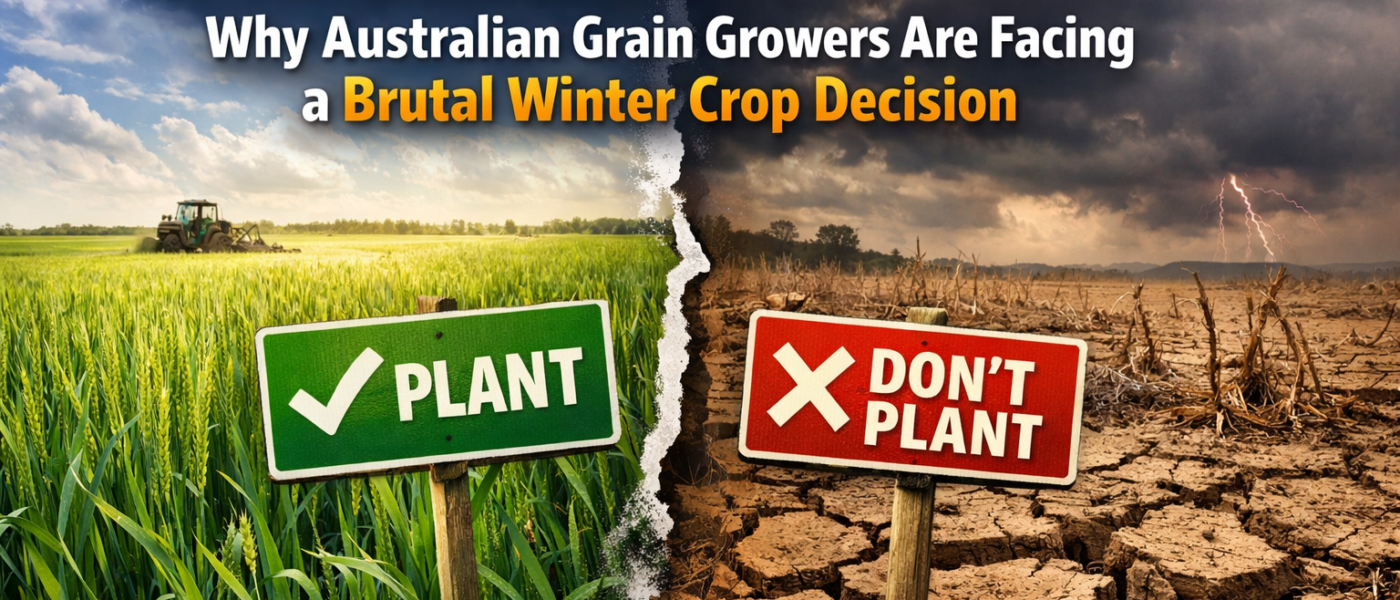

Why this year’s winter crop decision feels harder than usual
Every autumn brings a familiar question across Australian grain country: plant hard, plant cautiously, or hold off and wait. But in 2026, that choice has become far tougher than the usual seasonal gamble. Grain growers are not just weighing rainfall and soil moisture. They are also dealing with fuel uncertainty, fertiliser supply anxiety, and the growing fear that the economics of a full winter program may no longer stack up in some districts. ABC Rural reported in March that growers were facing fuel and fertiliser shortages just as winter-crop sowing began, while industry groups warned the disruption could materially affect planted area and production.
That changes the tone of the season. In a normal dry start, the big question is whether opening rain will arrive in time. In a high-cost, high-risk year, the question becomes whether it is wise to spend heavily on diesel, fertiliser and seed when yield confidence is already shaky. ABARES says the national outlook for May to July 2026 points to an increased probability of below-median rainfall across much of eastern and south-eastern Australia, adding another layer of downside risk to winter-cropping decisions.
Fuel and fertiliser uncertainty has hit at the worst possible time
The biggest problem is timing. Planting windows do not pause while supply chains sort themselves out. ABC Rural reported that the squeeze on diesel and urea landed just as southern growers were trying to make use of an early autumn break, leaving many worried not only about price but also about whether supply would remain reliable through sowing and early crop development.
For growers, that matters because fuel and fertiliser are not optional extras. Diesel gets the crop in, powers spraying and transport, and keeps the whole planting program moving. Nitrogen remains central to the economics of many wheat and canola programs. Once confidence in either input starts to wobble, the winter-crop decision becomes much more defensive. Growers start asking whether they should trim area, alter crop mix, pull back on input intensity, or preserve working capital instead of chasing a season that may never fully open.
Rain has created two very different winter-cropping stories
One reason this season feels so uncertain is that there is no single national planting picture. In parts of South Australia and some southern cropping areas, March rain created an early opportunity to get going. ABC Rural reported on 8 April that some South Australian growers had planted weeks earlier than usual after record-breaking rain, even while still worrying about input costs and supply continuity. The Bureau of Meteorology also says March rainfall was above average across most of South Australia, much of Victoria, and western and southern New South Wales.
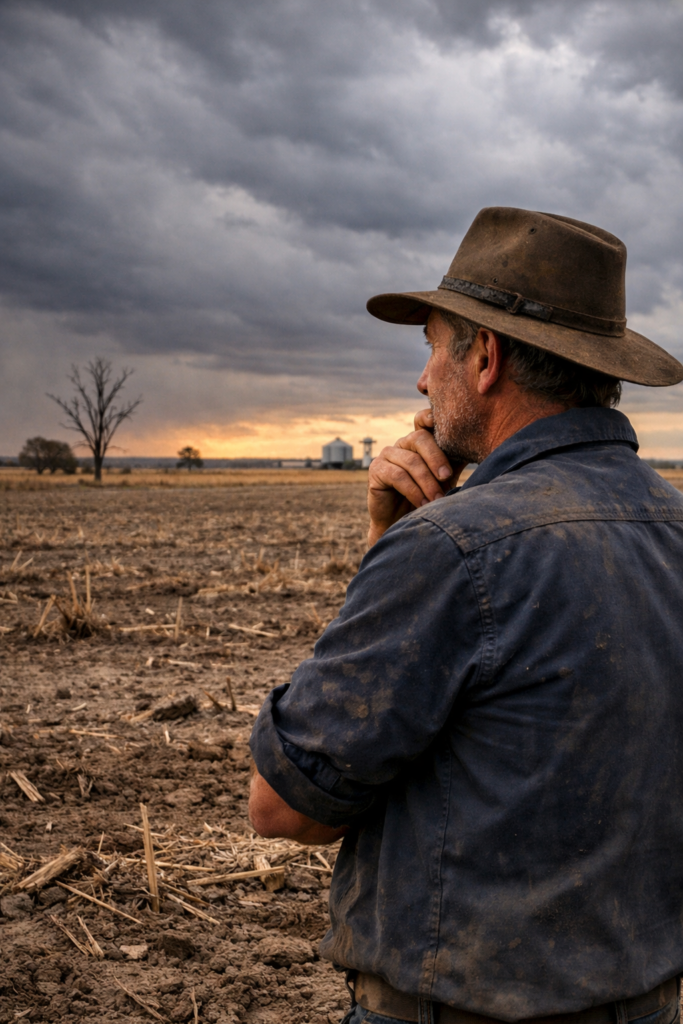
But the story is very different in drier northern country. The Bureau says March rainfall was below to very much below average across north-eastern New South Wales into parts of south-eastern Queensland, and root-zone soil moisture deficits expanded and intensified in those areas during March. That means many growers in the north are not simply deciding what to plant. They are deciding whether the profile is strong enough to justify planting at all.
In some regions, the question has shifted from “can I plant?” to “should I?”
That is the heart of the issue. A patchy start can often be managed if input costs are reasonable and the rain outlook improves. But when dry profiles are paired with expensive or uncertain nitrogen and volatile fuel costs, the risk-reward equation changes quickly. ABARES’ 9 April weekly update said only low rainfall totals were forecast over the following week for southern Queensland and northern New South Wales, while the broader May-to-July outlook remained dry-leaning across much of the east.
In practical terms, that means some growers are likely to scale back, switch crop type, reduce nitrogen plans or delay commitment until there is more confidence in moisture and supply. Others may decide the disciplined call is to preserve soil moisture, capital and flexibility rather than force a winter program into a poor opening. In 2026, restraint may prove just as professional a decision as planting early.
Crop choice is becoming a risk-management decision
This sort of season does not just affect total area. It also changes what gets planted. When fertiliser is expensive or difficult to secure, growers start looking differently at crop mix and input load. Higher-input options may still offer strong upside, but they also become harder to justify when the seasonal base is weak and the supply chain is unsettled. ABC Rural’s April coverage from South Australia highlighted exactly this tension, with growers saying the need for urea in crops like wheat and canola was becoming a major financial concern.
That is why 2026 looks likely to be a season where risk management shapes rotations more strongly than usual. Some growers will still back cereals or canola aggressively where moisture allows. Others may favour lower-input options, smaller programs or more conservative nitrogen strategies. The cropping plan becomes less about chasing the best gross-margin scenario on paper and more about protecting the business from a bad one in reality.
Diesel pressure is affecting more than just sowing costs
Fuel deserves separate attention because it touches almost every part of the farm business. Diesel is not just a seeding cost. It affects spraying, spreading, grain freight, fertiliser movement and general machinery use right through the season. ABC Rural reported that some regional fuel supplies had already come under pressure, while broader farm commentary has centred on the compounding effect of higher diesel prices on already tight budgets.
That matters because growers do not budget winter crops in isolation. They think about the whole life of the crop. If diesel stays volatile, then even growers who do plant are doing so with less certainty about their operating costs between sowing and harvest. That uncertainty alone can be enough to cool confidence in a marginal season.
The seasonal outlook is making the gamble feel harsher
Even if fuel and fertiliser supply improve, rainfall confidence is still doing a lot of the emotional and financial heavy lifting. ABARES says much of eastern and south-eastern Australia faces an increased probability of below-median rainfall through May to July, which it explicitly says increases downside production risk for the winter-cropping season. The Bureau’s drought statement also points to below-average root-zone soil moisture in north-eastern New South Wales into south-eastern Queensland, which is exactly the sort of profile that makes growers nervous about committing expensive inputs too early.
That does not mean growers cannot still grow a profitable crop. It does mean the margin for error is thinner. Growers can usually handle one major risk at a time. A dry opening can sometimes be managed if inputs are available and affordable. Expensive inputs can sometimes be justified if moisture and outlook are strong. Carrying both risks together is what makes this season feel especially brutal.
There is no single right answer this season
One of the clearest lessons from current reporting is that growers across Australia are not facing the same decision. Some southern growers have already rolled early to capture moisture. Others are still deeply uneasy about whether fuel and fertiliser will remain available and affordable. Meanwhile, parts of the north are still looking at poor soil moisture and a weak near-term rainfall outlook.
That is why 2026 is shaping up as a season where smart businesses may make very different calls. Some will plant hard and back their system. Some will trim area and reduce exposure. Some may sit on the sidelines and protect moisture and cash flow for another opportunity. None of those decisions automatically signal weakness. In a year like this, they can all be signs of disciplined management.
Final word
So, to plant or not to plant? For many Australian grain growers, that is not just a catchy headline. It is the defining autumn question of 2026. The combination of fuel uncertainty, fertiliser shortages, patchy rainfall and a dry-leaning seasonal outlook has made winter cropping a far more difficult decision than usual. Some growers will still see enough moisture and enough margin to press ahead. Others will decide the wiser move is to scale back, change course or wait.
What makes this season so challenging is not any single issue on its own. It is the way several risks have landed at once. And in that sort of year, the best decision may not be the boldest one. It may simply be the one that leaves the business in the strongest position for whatever comes next.