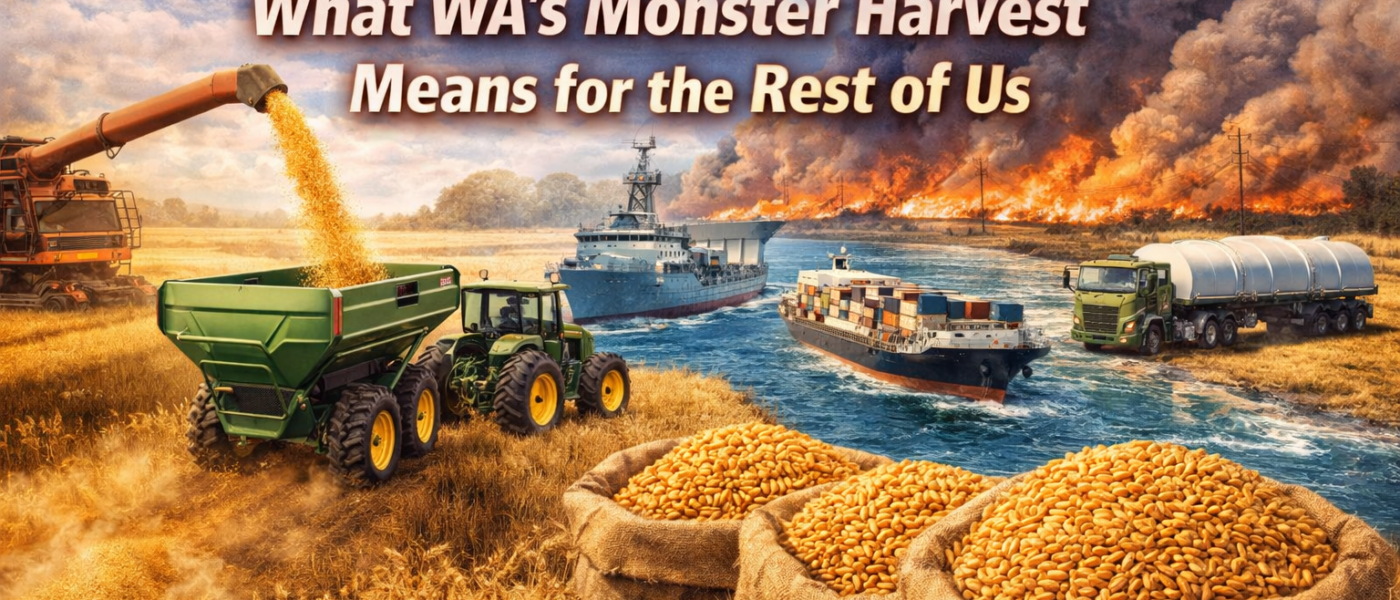

There’s a number doing the rounds in Australian grain circles that deserves a moment of appreciation before we start pulling it apart: 27.35 million tonnes. That’s how much grain Western Australia produced in the 2025–26 season, according to the Grain Industry Association of Western Australia’s final crop report. It’s the state’s largest harvest ever, two million tonnes heavier than the previous record, and the fourth time in five years that WA has cracked the 20-million-tonne mark.
To put it in terms that might land outside the grainbelt: if you loaded all that grain into road trains and parked them nose to tail, you’d wrap around Australia more than 5,000 times. CBH Group, the cooperative that handles the vast bulk of WA’s crop, used exactly that comparison during harvest—and then kept receiving grain for another three weeks.
But a record crop, as any grower who’s lived through one knows, isn’t a champagne occasion by default. The story of WA’s 27.35 million tonnes is also a story about what happens when the supply chain strains under its own success, when port capacity becomes a chokepoint, when prices soften under the weight of abundance, and when the rest of Australia’s grain industry has to figure out where it fits in a world where the west coast keeps getting bigger.
How WA Grew Its Way to a Record
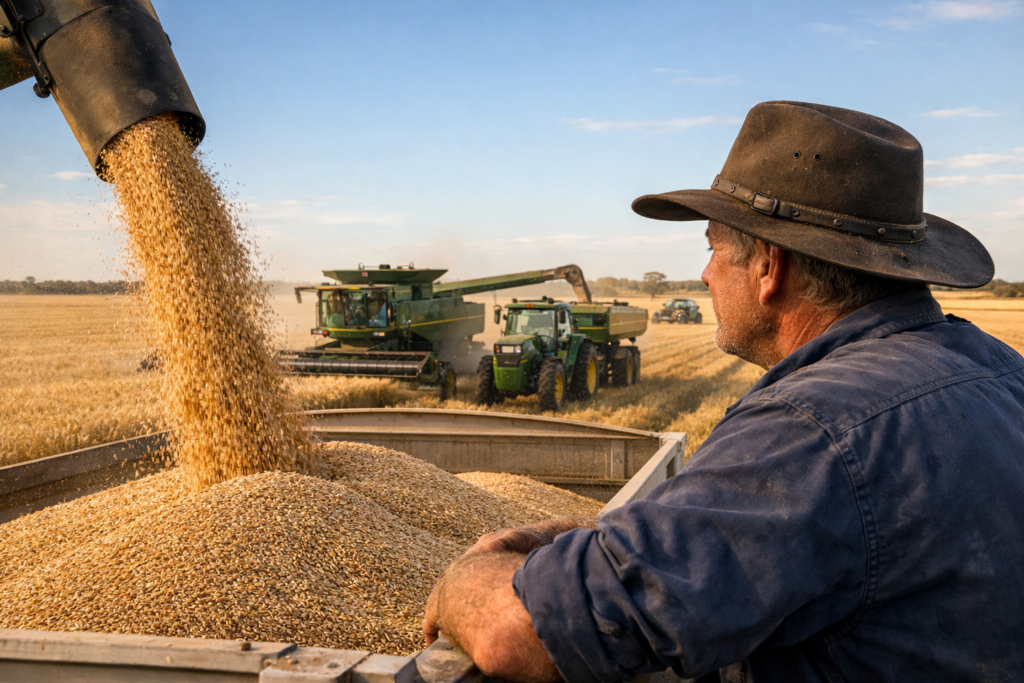
The recipe for WA’s monster 2025 crop reads like a wishlist that the weather gods rarely grant in full. Adequate rainfall arrived in July and August across most of the grainbelt, setting up strong vegetative growth. Then came the clincher: mild temperatures during grain fill, the critical window when warmth and moisture need to be perfectly balanced. Crops pushed water use efficiency to exceptionally high levels, and yields responded accordingly.
GIWA’s report author Michael Lamond attributed the record to both nature and ambition. A 6.8 per cent expansion in total crop area from the previous record year of 2022 contributed, with most of that growth concentrated in higher-rainfall regions where yield potential is greatest. Growers shifted their rotations noticeably: barley plantings were up 26.4 per cent year on year, lupin area climbed 17.4 per cent, and oats—for both grain and hay—surged an eye-catching 65.1 per cent. Wheat and canola, meanwhile, saw modest area reductions of 3.3 and 7.3 per cent respectively.
The result across the state’s major crops: 13.3 million tonnes of wheat, 7.64 million tonnes of barley, 4.37 million tonnes of canola, 1.02 million tonnes of oats and 901,000 tonnes of lupins. That lupin figure is the highest in more than 15 years. And it was barley—not wheat—that emerged as the star performer. GIWA reported barley as more profitable than wheat in many areas, having avoided the late frost event that Lamond estimated shaved over a million tonnes off WA’s wheat production and caused quality headaches through the central cropping zones.
Canola, as has become the pattern in recent years, was the most profitable crop for most growers. The combination of above-average yields and strong prices gave it a returns edge, and GIWA expects the area sown to canola to increase further in 2026, especially if ex-cyclone Mitchell’s late rains deliver the subsoil moisture needed for an early seasonal break.
The Logistics of Plenty
Producing 27 million tonnes of grain is one thing. Moving it is another. CBH Group received 24.1 million tonnes through its network—the largest volume the cooperative has ever handled—with the remaining three-plus million tonnes going to Bunge’s WA facilities, private on-farm storage, and direct contracts for seed, malt and dairy feed.
The scale of the storage challenge was laid bare by a single statistic: 16.3 million tonnes of grain stored under tarp in open bulkheads, smashing the previous record of 14.9 million tonnes set in 2022–23. These aren’t shiny silos—they’re enormous gravel pads with steel frames and industrial tarps, the unglamorous but essential infrastructure that keeps WA’s supply chain functional when the bins overflow. Every harvest season, WA’s landscape transforms into a patchwork of white-tarped grain mountains, each one a testament to both the scale of production and the limits of permanent storage.
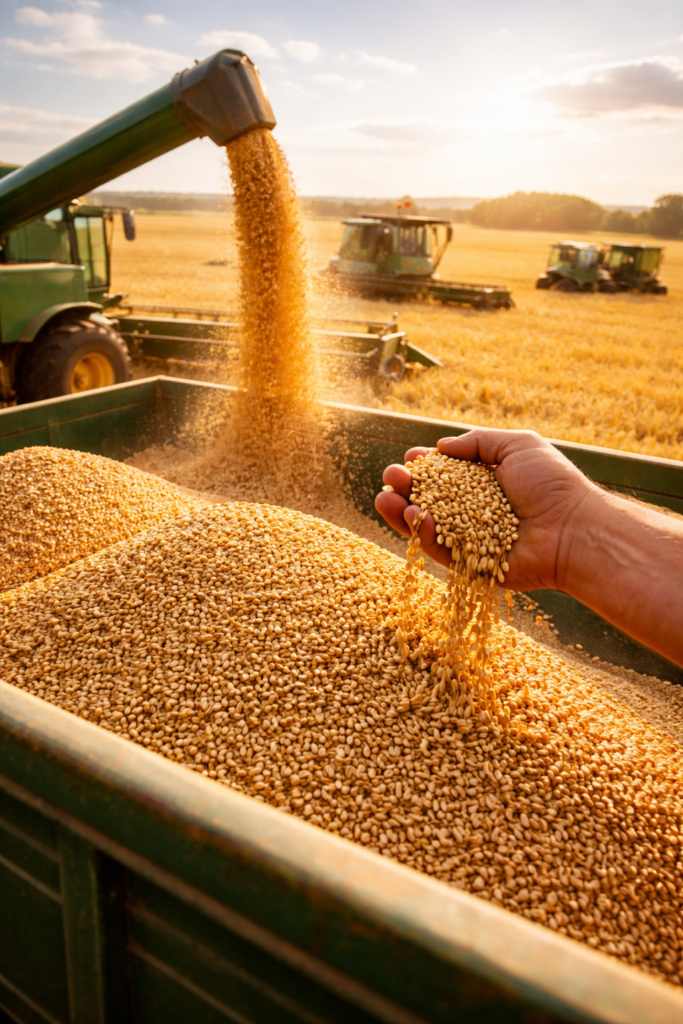
CBH shipped more than two million tonnes through its four port terminals in December alone, the second-highest monthly total on record, and offered what it described as a record volume of export capacity heading into 2026. The WA Government has also stepped in with rail upgrades under the Agricultural Supply Chain Improvements program, extending rail sidings and increasing loading efficiency at key inland sites. At Corrigin, a major upgrade added four new open bulkheads, doubled the sample hut’s capacity, and installed a new 39-metre outloading weighbridge—just in time for the record crop.
But even with all that investment, the sheer volume creates bottlenecks. When three crops—wheat, barley and canola—all need to move through the same four port zones in the same export window, something has to wait. S&P Global flagged this exact tension in its commodities outlook, noting that canola and barley exports were consuming shipping capacity that might otherwise go to wheat, making Australian wheat less price-competitive in Southeast Asian markets where Black Sea and Argentine suppliers were already circling.
Barley’s Moment in the Sun
If the WA harvest had a standout commodity, it was barley—and not just because of the 7.64 million tonnes produced. Nationally, ABARES forecast a record 15.7 million tonnes of barley for 2025–26, a figure 33 per cent above the 10-year average. WA contributed roughly half of that total, and the demand side was equally buoyant: China has been buying aggressively since tariffs were removed in August 2023, taking approximately 70 to 80 per cent of Australia’s feed barley exports and dominating malting shipments as well.
In December 2025, Australia shipped 1.22 million tonnes of barley in a single month. China took around 700,000 tonnes of feed barley and 261,000 tonnes of malting barley from that total. Saudi Arabia was the next largest buyer. On-farm, barley avoided the frost and quality issues that dogged wheat in central WA, and the premium for malting grades held up well. GIWA noted that barley profitability exceeded wheat in many regions and predicted a further expansion in barley area for the 2026 season.
The flip side? A record crop flooding into a market that’s heavily concentrated on one buyer raises the question the industry thought it had answered during the tariff years: what happens if Chinese demand slows? Feed barley and milling wheat were trading at near parity—around $320–325 per tonne at WA port—which is unusual and reflects the strength of international barley demand. But Rabobank flagged in early 2025 that Chinese authorities were encouraging domestic grain procurement, a signal that the import tap could tighten without warning.
What the East Coast Is Thinking
For growers in Victoria, South Australia and southern New South Wales, WA’s record crop is a source of both admiration and anxiety. The east came into the 2025–26 season recovering from drought-affected harvests in key regions, with ABARES forecasting production lifts in SA and Victoria but a 14 per cent fall in NSW wheat output due to poor conditions in the south of the state.
When the nation’s export engine is running at full throttle out of the west, it creates competitive pressure that eastern growers feel keenly. WA grain, by virtue of its proximity to Asian markets and the efficiency of the CBH-to-port supply chain, has a natural freight advantage into Southeast Asia, China and the Middle East. That advantage widens in a big crop year when WA sellers are aggressive on price. The result, noted by Asian millers and grain traders, is that Australian wheat offers—especially lower-protein grades like ASW from WA—can undercut eastern states’ grain in export markets, pushing Black Sea and Argentine product into the slots that eastern Australian wheat might otherwise fill.
Domestically, the picture is more nuanced. Dry conditions across parts of SA, Victoria and southern NSW have meant firm livestock feeding demand, particularly for barley. The Elders cropping update noted that barley in the southern feed zone would be increasingly difficult for exporters to prize out of growers’ hands, with more livestock moving into containment and on-farm demand rising. That domestic floor provides some price support that insulates eastern growers from the full downward force of WA’s export surplus.
But the structural trend is hard to ignore. WA’s share of national grain production has been climbing steadily, driven by expanding cropping area, improving varieties from programs like InterGrain, and a run of favourable seasons that would have seemed improbable a decade ago. If WA can produce 27 million tonnes in what Lamond described as a season with adequate—not exceptional—rainfall across much of the state, the ceiling may not have been reached yet.
The Land Rush
One consequence of WA’s sustained production boom has been a transformation in farmland values, particularly in the state’s Great Southern and south coast regions. Grain Central reported that Frankland River properties that sold for $13,590 per arable hectare in December 2024 were followed by sales achieving $16,000 and $17,300 per arable hectare just 13 months later—a 27 per cent jump.
The demand is being driven not just by locals looking to expand, but by farmers from elsewhere in the state—and from the east coast—seeking the consistency and reliability that WA’s higher-rainfall zones have demonstrated over the past half-decade. With the live sheep export trade under pressure, some traditional livestock operators are converting pasture to cropping, further expanding the production footprint.
At Munglinup, near Esperance, the trend was visible in the numbers. The Esperance zone delivered 4.05 million tonnes to CBH in 2025–26, beating its previous record by 305,000 tonnes. Part of that increase reflects pasture-to-cropping conversion, alongside better varieties and agronomic improvements. On the south coast, growers are investing in on-farm dryers, blending facilities and fixed storage to manage the unique challenge of harvesting in a high-moisture coastal environment—investments that would have seemed extravagant a few years ago but now look essential.
Tight Budgets Despite Big Tonnes
Here’s the paradox that tempers the celebrations: a record crop does not automatically mean a record profit. GIWA’s Lamond was candid on this point. While growers in the better areas enjoyed good operating margins thanks to high yields, the central regions—where frost damage was more severe and yields were lower—recorded significantly weaker returns than in 2022. Across the state, total production value exceeded the previous record, but that headline figure was skewed towards the higher-rainfall perimeters.
With grain prices well below the highs of 2022, small variations in farm gate returns—quality downgrades, screenings deductions, the difference between malt and feed barley—pushed breakeven yields to historically high levels. Projected budgets for 2026 are tight for many, even though major input costs like fertiliser and crop protection haven’t spiked. The Middle East conflict has injected a fresh layer of uncertainty on the fertiliser front, with Australia sourcing roughly 68 per cent of its urea from the region and the Strait of Hormuz disruptions threatening supply chains ahead of the winter seeding window.
Lamond’s report noted that overall sentiment heading into the 2026 growing season is positive, but growers remain concerned about external factors affecting global trade—to which WA, as an overwhelmingly export-oriented state, is heavily exposed. When your grain must travel by rail to port and then by ship to a customer in Beijing, Riyadh or Jakarta, you’re only ever one geopolitical shock away from a supply chain headache.
What Comes Next
The question nobody can answer with certainty is whether WA’s production trajectory is sustainable. Four record or near-record crops in five years suggests something structural, not just lucky weather. The expansion of cropping into higher-rainfall zones, the adoption of precision agriculture, improved varieties, and better agronomic practices are all contributing to a long-term yield trend that shows no sign of flattening.
But the industry also knows that climate variability hasn’t gone away. A poor break to the 2026 season, a return to El Niño conditions, or a severe frost event across a wider area could see production retreat sharply. The GIWA report noted that if the break is late in 2026, fallow in lower-rainfall regions and caution on canola planting in medium-rainfall areas could trim the crop. WA farming is still dryland farming, and dryland farming remains a bet on the weather.
For the rest of the Australian grain industry, the lesson of WA’s 27 million tonnes is twofold. First, the west coast’s growing dominance is reshaping national market dynamics in ways that eastern growers, traders and supply chain participants need to adapt to. WA is not just a big producer—it is increasingly the price-setter, the export pace-setter, and the yardstick by which Australian grain is measured in international markets. Second, the infrastructure story—rail, port, storage, on-farm investment—is now as important as the agronomic story. Producing record crops is remarkable. Getting them to port and onto ships at a competitive cost is what actually pays the bills.
WA Agriculture and Food Minister Jackie Jarvis summed up the dual challenge neatly: the international grain market is highly competitive, and for Australia to maintain and grow market share, the efficient movement of grain to port is essential. It’s a statement that could serve as the motto for the entire western grainbelt—a region that keeps defying expectations, and keeps having to build bigger systems to match its own ambition.
For now, though, the number speaks for itself: 27.35 million tonnes. If you’re a WA grain grower, you’re allowed a moment of pride. If you’re a grower anywhere else in Australia, you’re allowed a moment of wondering what that number means for you.