
There are some stories in agriculture that arrive with a bang — drought declarations, flood maps, a plague of mice. And then there are the quieter threats, the ones that creep in through the gate and sit there in plain sight. A diesel squeeze is one of them.
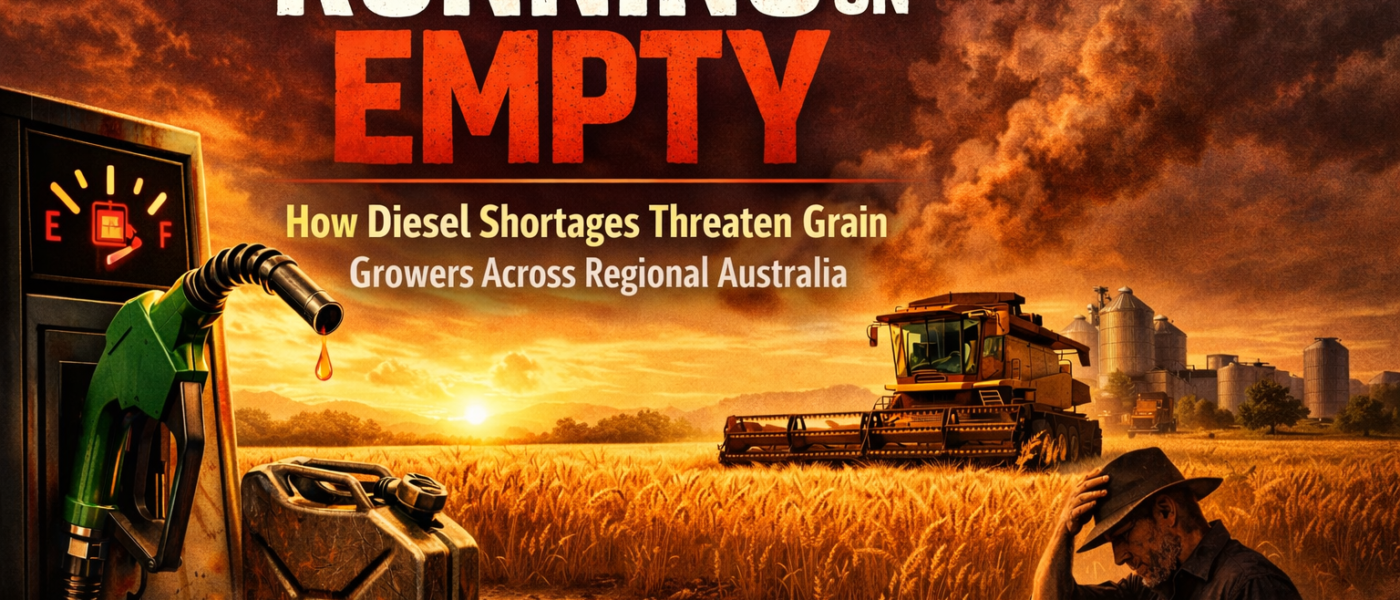
Right now, grain growers across regional Australia are staring at a problem that is both immediate and unnerving: diesel is getting dearer, harder to secure in some country areas, and more disruptive with every day it lingers. Nationally, the federal government says fuel supplies remain secure. But on the ground, farmers and regional distributors are reporting rationing, delayed deliveries and difficulty sourcing the volumes they need. That gap between the official line and the lived reality in the paddock is where this story really sits.
The first thing to understand is that grain production does not merely “use” diesel. It depends on it. GrainGrowers says Australia’s grain industry relies on secure, reliable and affordable liquid fuel access at every stage, from sowing and harvest through to transport and export. In the same policy material, the organisation notes freight alone accounts for 30 per cent of the price of grain at port — a reminder that fuel pain is not confined to the farm gate; it follows the crop all the way down the chain.
That is why this moment matters so much. The latest national data reported by the ABC, drawing on Australian Institute of Petroleum figures for the week to 8 March, shows the average retail diesel price rose 15.6 cents to 196.5 cents per litre. At the same time, the ACCC says the international benchmark for refined diesel has increased significantly over the past week. In other words, growers are not imagining it: the diesel market has moved sharply, and quickly.
For a city motorist, a rise like that is painful. For a grain grower, it is structural. Diesel powers tractors, spray rigs, headers, chaser bins, augers, telehandlers, generators and the trucks that link farm to storage, feedlot, mill, railhead and port. When diesel jumps, the cost of planting rises, the cost of crop protection rises, the cost of moving grain rises, and the confidence to lock in logistics starts to wobble. What looks like a bowser story in town becomes a whole-of-supply-chain story in the bush.
And price is only half of it. Availability is the other half — and in some regions, that is the more alarming one. ABC reporting this week said some wholesalers had begun rationing fuel and that farmers were only receiving a fraction of what they had ordered, if anything at all. One distributor told the ABC his available supply had dropped from as much as 450,000 litres a day to about 45,000. The same report quoted NSW Farmers’ Grains Committee chair Justin Everitt saying it was becoming very hard to get fuel delivered on farm. That matters because broadacre growers do not simply duck down to the local servo with a jerry can when they are short. A cropping business can burn through serious volume in a narrow operational window.
 That narrow window is what makes the grain sector especially vulnerable. The timing of grain farming is unforgiving. If diesel becomes expensive for a fortnight, that hurts margins. If it becomes scarce during sowing, spraying or harvest, that threatens output. Cropping does not politely wait for the next tanker. Miss a planting opportunity, delay a spray pass, or stall harvest logistics at the wrong time, and the financial cost can far exceed the fuel bill itself. This is particularly relevant as many eastern and southern grain businesses prepare for winter-crop planning and field operations, while summer-crop harvest and haulage are still active in parts of Queensland and New South Wales. ABARES says sorghum production is forecast at 2.5 million tonnes nationally in 2025–26, with Queensland at 1.675 million tonnes and New South Wales at 840,000 tonnes, while the 2025–26 winter crop is estimated at 68.4 million tonnes, the second highest on record. Those are large tonnages sitting behind an enormous fuel task.
There is another layer to this: grain regions are often far from refining capacity, major terminals and capital-city priority. That means country towns feel disruption differently. Recent reporting from regional Australia shows independent and regional operators being hit hardest, with demand surging and some distributors receiving only a small share of their usual allocations. In South Australia’s rural districts, for example, local reports described diesel running out and farmers making longer trips just to fill up. Even when there is technically enough fuel in the system nationally, localised disruption can still cripple agricultural work if the right fuel does not arrive in the right place at the right time.
For the grain trade, the pressure does not stop once the crop is grown. It only changes shape. Sheep Central reported today that traders told Grain Central rising diesel prices could add 10 per cent to the benchmark long-haul grain freight rate, based on an indicative $35 per tonne for a 300-kilometre run into Brisbane. That is not a rounding error. That is the sort of extra cost that can alter selling decisions, squeeze basis, delay movement and make already-cautious buyers even more selective.
Road freight operators are already warning they cannot absorb the hit. The Australian Trucking Association said on 6 March that the market price for diesel had risen from A$130 to almost A$220 per barrel since 27 February, and that retail diesel prices had increased almost 19 cents per litre since Sunday. The ATA said fuel is typically one of the top three costs for a trucking business and warned operators would need to pass higher costs on to customers. ABC reporting on 9 March added another hard truth: one in 12 road transport businesses shut their doors in the year to November 2025. In other words, the grain industry is leaning on a freight network that was already under financial strain before this fuel shock arrived.
That is where the risk to grain regions becomes broader than farm business budgets. In much of rural Australia, grain is not a stand-alone industry. It is the pulse of the local economy. When diesel bites hard, it affects growers, contract harvesters, freight operators, machinery dealers, agronomists, bulk handlers, container packers, local workshops and the country towns that service them. A tight diesel market can slow grain movement, which slows cashflow, which dulls spending confidence across an entire district. That is how a global fuel shock becomes a main street story in places hundreds of kilometres from a port.
There is also a strategic vulnerability sitting underneath all of this. GrainGrowers says 91 per cent of Australia’s liquid fuels are imported, and its recent fuel-security report argues that current global instability has again exposed the country’s dependence on overseas supply. The federal government’s minimum stockholding framework requires baseline diesel stocks of 20 days for refiners and 32 days for importers, while government statistics say average diesel stocks held under that regime in 2024–25 were equivalent to 33 days of normal consumption. Chris Bowen said in a 3 March press conference that Australia had 34 days of diesel on hand at that time. Those figures are not evidence of an empty nation. But they do show why country industries like grains get nervous so quickly: diesel is critical, imported, and not something anyone in agriculture can do without for long.
The government’s argument is that the immediate issue is not that Australia has suddenly stopped receiving fuel, but that panic buying and demand spikes are stressing distribution. That may well be true at the national level. Yet for grain growers, the distinction can sound academic. Whether a farm misses a delivery because there is no fuel in the country or because the supply chain has become chaotic, the tractor still stops all the same. Farmers do not sow hectares with reassurance. They sow them with diesel.
So what happens from here?
If the diesel squeeze eases quickly, the grain sector will likely wear the hit as another ugly but temporary cost surge in a business already accustomed to volatility. But if elevated prices and patchy supply persist into key fieldwork and freight periods, the effects will spread. Growers may delay non-essential operations, review freight timing, hold grain longer, or become even more conservative in forward commitments. Transport operators will push harder on fuel levies and surcharges. Buyers and end users will start to factor freight risk more aggressively into bids. And the wider public, eventually, will see some of that pain come through in food prices and regional inflation.
For the grain-growing regions of Australia, this is a reminder as old as farming itself: the harvest might be grown from rain and soil, but modern agriculture runs on energy. When diesel becomes uncertain, the whole machine shudders.
And that is why this story matters. Not because it is dramatic, but because it is fundamental. In grain country, diesel is not a side issue. It is the bloodstream.