
Why Australian Grain Grades Matter
In the Australian grain trade, a “grade” is really a shorthand way of telling buyers what sort of grain they are getting. It signals whether a parcel is suitable for premium milling, malting, noodles, pasta, general-purpose food use, feed, or something more specialised. Australia’s system works because it combines variety classification with post-harvest testing: Grains Australia manages the classification side for major grains, while Grain Trade Australia’s trading standards set the quality rules used in commercial trade and are updated each year on 1 August.
That is why two loads of grain that look similar in the paddock can end up with different values at receival. One may fit a premium class and meet every quality test; the other may miss on protein, screenings, weather damage, moisture, variety, or another parameter and drop into a lower-value grade. The whole point of the system is to create consistency and transparency for growers, traders, processors and exporters.
Grain Class, Grain Grade and Grain Standard: What Is the Difference?
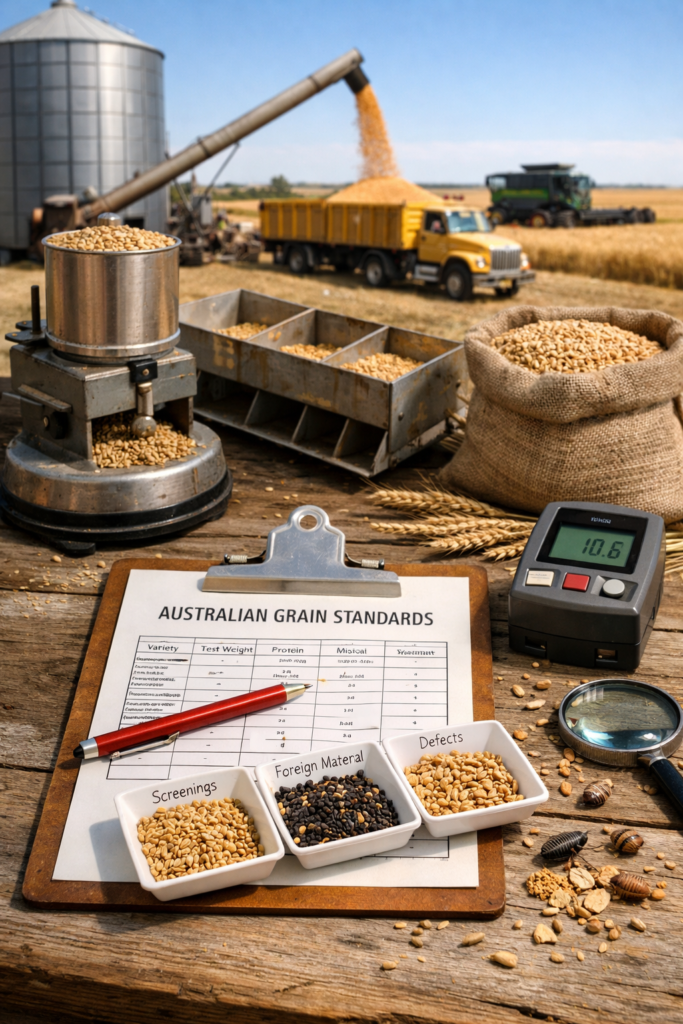
These three terms get mixed up all the time, but they are not the same thing. In plain English, a class is the broad market bucket a variety belongs to, based on its expected end-use quality. A grade is the actual receival or trading outcome for a load in a given season. A standard is the rulebook that says what that load must meet on things like moisture, protein, screenings, defects and contaminants. Grains Australia’s wheat pages make clear that wheat is classified into classes with distinct quality attributes, while GTA’s trading standards set the formal rules used in commercial grain trade and are reviewed annually.
A simple way to think about it is this: the variety gives you the opportunity to make a certain class, but the sample test decides what grade you actually get. Grains Australia’s current wheat variety messaging says the master list records the highest possible class for a variety in each zone, but that deliveries are still subject to the season’s GTA wheat standards at receival.
Who Sets the Rules in Australia?
For wheat and barley classification, Grains Australia is the key industry body. It manages wheat classes and the malting barley classification process, and it is also developing pulse classification frameworks, with lentils already having a framework and more work underway for faba beans, lupins, chickpeas and other pulses.
For trading standards, Grain Trade Australia is the main reference point nationally. GTA says its trading standards are critical tools for commercial trade, reviewed annually with industry input, and reissued each year on 1 August. In Western Australia there is an added wrinkle: GIWA acts as the caretaker of WA’s coarse-grain receival standards and reviews them annually, while GIWA notes that wheat standards are managed by GTA.
There is also a food-safety and market-access layer sitting over the top of grading. The Department of Agriculture, Fisheries and Forestry says the National Residue Survey is part of Australia’s system for managing chemical residues and contaminants, helping confirm compliance and support domestic and export market access. In other words, grain is not just graded for functionality and appearance; it also has to be clean and compliant.
How Australian Wheat Grades Work
Australian wheat is divided into classes with different end-use strengths. At the premium end, APH is the high-protein class, with a minimum protein level of 13%, aimed at strong noodle and bread applications. AH sits below that with a guaranteed minimum protein of 11.5% and is targeted at breads, flat breads and steamed products. APW has a minimum protein of 10.5% and is positioned as a versatile multi-purpose class, especially for several noodle styles and flat breads.
Then you move into broader utility classes. ASW is the classic general-purpose white wheat class used for straight milling or blending. AWW, introduced in 2021, is a value class for dry, clean, hard-grained white wheat with competitive milling performance and sound falling number, but with more limited end-product expectations than APH, AH or APW. Specialty classes also exist, including ASFT for soft wheat products like biscuits and cakes, ADR for durum semolina and pasta, ANW and APWN for noodle markets, and AIW for novel wheats traded in more closed-loop pathways. Grains Australia also notes that Australian Feed is not part of the formal wheat classification system, even though feed varieties can still appear on the variety master list.
That last point is worth spelling out in plain English: feed wheat is not automatically “bad wheat.” It simply means the grain or the variety does not fit one of the formal milling or specialty classes, or that the delivered parcel missed the quality settings needed for a higher-value grade. Sometimes that is because of season, sometimes variety, sometimes protein, and sometimes weather damage or screenings.
How Australian Barley Grades Work
Barley confuses people because there are really two hurdles. First, the variety itself must be recognised as malting barley through Grains Australia’s malting barley classification process. Grains Australia says varieties in that program are assessed over two seasons using pilot and commercial malting and brewing methods, and they are either classified as malting barley or designated by non-malting trading terminology if they fail to achieve malting status.
Second, even a recognised malting variety still has to meet the receival standard for the actual load. Grains Australia states that all barley varieties are subject to either GTA trading standards or GIWA grain receival standards when delivered into receival sites. So a malting variety does not automatically become malt on the weighbridge; the grain still has to make the quality spec. If it misses, it can be downgraded into a non-malt or feed-type outcome depending on the applicable standards and buyer program.
What the Main Grain Quality Tests Actually Mean
Protein
Protein is one of the best-known tests because it often drives value in milling wheat. In plain English, protein is a rough indicator of how much strength and baking performance the flour is likely to have. That is why classes like APH, AH and APW are tied to minimum protein levels, while soft wheats such as ASFT have a guaranteed maximum protein level because low strength is part of what those markets want.
Moisture
Moisture is simply the amount of water in the grain sample. It matters because grain that is too wet is harder to store safely and more likely to run into mould, insect or heating problems. GTA standards define moisture as the amount of water present in the sample as determined by the relevant analytical method, and receival standards use moisture limits because safe storage and transport depend on it.
Test Weight
Test weight is one of the easiest tests to explain: it is a measure of grain density, expressed in kilograms per hectolitre. A denser grain sample generally points to better grain fill and sounder grain, though it is not a perfect measure of milling performance on its own. GTA’s technical guide says test weight measures how much a specific volume of grain weighs, and the standards refer to it as a density measure.
Screenings
Screenings are the smaller, lighter or shrivelled material that falls through the prescribed screen. In practical terms, more screenings usually mean less usable grain and more trouble for millers, maltsters or end users. Grains Australia says wheat standards require measurement of screenings, and GTA standards define screenings as the unmillable material below the screen.
Falling Number
Falling number sounds technical, but the plain-English version is simple: it is a way of checking whether weather damage and sprouting have activated too much enzyme in the grain. GTA defines it as a test that measures the degree of weather damage, based on alpha amylase breaking down a starch gel. Low falling number generally means the grain has been affected by sprouting or pre-harvest weather damage and is less desirable for many flour and malt uses. GTA also notes that where a falling number test is conducted, it overrides the visual grain assessment for sprouting.
Defects and Contaminants
This is the catch-all area covering things such as stained grain, fungal damage, field weathering, heat damage, sprouting, insects, weed seeds and foreign material. GTA standards say these definitions are used alongside the Visual Recognition Standards Guide, which gives samplers and assessors photo references for what particular defects look like. This is important because grading is not just about lab numbers; it is also about consistent visual assessment of the physical grain sample.
Why a Load Can Miss the Premium Grade Even When the Crop Looked Good
From a grower’s point of view, the frustrating part is that a crop can look terrific in the paddock and still miss a top grade. That happens because the final outcome depends on the delivered parcel, not the visual impression from the paddock. A load can miss on protein, screenings, moisture, sprouting, density, defects, contamination, or simply because the variety does not sit in the class the buyer needs. Grains Australia’s wheat information is explicit that GTA wheat standards rely on post-harvest testing of physical characteristics and defects.
This is also why growers sometimes hear the phrase “good grain, wrong market.” A sound parcel may still not suit a premium noodle, bread or malt stream if it does not line up with the relevant class, variety, protein window or end-use specification. The standards are not judging whether the grain is “nice” or “ugly”; they are judging whether it matches a commercial use.
Insects, Residues and Other “Hidden” Quality Risks
One of the less glamorous parts of standards is that some things can knock grain out regardless of how good it looks. GTA’s Code of Practice says the industry adopts a nil tolerance for live stored grain insects on outturn to domestic or export markets. That means a parcel can be unacceptable even if protein, test weight and screenings all look fine.
Chemical residues are another example. DAFF says the National Residue Survey helps confirm whether residues are below set limits and supports market access. So when people talk about “quality standards,” they do not only mean milling and malting traits. They also mean food safety, chemical compliance and buyer confidence.
Why Standards Change by Season, Region and Buyer
Australian grain grades are not completely fixed in stone. GTA notes that standards are reviewed every year and new or updated versions are released on 1 August. Its wheat standards also note that some grades are common nationwide, while others may only be introduced in certain seasons or regions to meet particular customer or quality-management needs.
That is why growers need to pay attention each season rather than relying on memory. The class attached to a variety may be stable, but the actual receival settings, segregations, buyer programs and regional standards can shift. Western Australia adds another layer because GIWA reviews coarse-grain receival standards annually for WA conditions and market requirements.
Final Word: The Plain-English Version
The simplest way to understand Australian grain grades is this: the variety tells buyers what the grain could be, and the sample tests tell them what it actually is. If the right variety arrives dry, sound, clean and on spec, it has a shot at a premium class or grade. If it misses on key tests or defects, it drops into a lower-value bucket. That system can feel harsh in a tough season, but it is also the reason Australian grain has a reputation for consistent, market-targeted quality.