
Somewhere on a Darling Downs paddock right now, a header is chewing through sorghum that’s yielding five, six, maybe seven tonnes to the hectare. The grain is dense, the colour a rich red-brown, the stalks standing upright and cooperative. The grower might grumble about the price—sorghum growers always grumble about the price—but the yield would have seemed hallucinatory to the farmers who first planted this crop in Australia a century ago.
Grain sorghum, or milo as the old-timers still occasionally call it, has undergone one of the most dramatic transformations of any crop in Australian agriculture. From an unreliable, small-grained, lodging-prone oddity grown opportunistically in Queensland’s summer, it has become a cornerstone of northern cropping systems, producing more than two million tonnes a year and anchoring rotations from the Central Highlands to the Liverpool Plains. The story of how it got there is, at its heart, a story about breeding—about the patient, unglamorous, generational work of turning a wild African grass into a precision crop.
The Early Days: Open Pollination and Low Expectations
Sorghum has been cultivated in Australia since the early 1900s, initially as a stock feed in summer-rainfall-dominant regions. The first varieties were open-pollinated cultivars imported from the United States: names like Caprock, Martin, Wheatland and Alpha that sound like country towns but were actually the genetic building blocks of an industry. These early introductions were, to put it charitably, inconsistent. They tended to produce small grain, lodge badly, mature unevenly and yield unreliably. Planting rates were enormous by modern standards—up to 10 kilograms per hectare, or 300,000 to 400,000 seeds—because so much of the plant stand simply failed.
The crop was considered opportunistic. You planted it when summer rain arrived, hoped for the best, and accepted whatever the paddock gave you. It wasn’t the kind of crop you built a farming system around.
Things began to change in the 1960s with the development of hybrid sorghum. US-based seed companies, seeing potential in Australia’s summer cropping zones, started breeding and testing existing American hybrids for local conditions. But the real catalyst came in the 1970s. Wheat quotas imposed by the Australian Wheat Board forced growers to look for alternative crops, and sorghum was suddenly interesting in a way it hadn’t been before. Seed companies ramped up investment, and the area sown to grain sorghum expanded rapidly—particularly in the Central Highlands, the Callide-Dawson region, and eventually into northern New South Wales.
There were some wild experiments along the way. At Scotts Creek in the Northern Territory, Bryce Killen ran an ambitious program growing sorghum during the wet season, peaking at almost 10,000 hectares planted in 1972–73 for a return of 18,000 tonnes of grain. Low prices, freight costs, weed infestations and the beef slump of the mid-1970s eventually sent the operation into receivership. Wellington-based grain trader Michael White later recalled buying a parcel of that NT sorghum for the princely sum of $16 per tonne. The NT experiment ended, but it showed that sorghum could produce in environments nobody had previously considered.
The Midge Problem and the MR Revolution
By the 1980s, sorghum midge had become the single biggest constraint on the crop’s expansion. The tiny orange fly, Stenodiplosis sorghicola, lays its eggs in flowering sorghum heads and can devastate yields in late-planted crops. For decades, growers relied on insecticides and early planting to manage the pest, but neither approach was reliable across all environments.
The breakthrough came from the public breeding program run by the Queensland Department of Primary Industries, later in partnership with the University of Queensland and funded by the Grains Research and Development Corporation. Researchers including Bob Henzell and, later, Professor David Jordan developed germplasm with genetic resistance to sorghum midge—the “MR” lines that would revolutionise the industry. This wasn’t a single gene fix. Midge resistance in sorghum is a complex trait involving multiple mechanisms, and incorporating it into high-yielding commercial hybrids required years of crossing, selection and field testing.
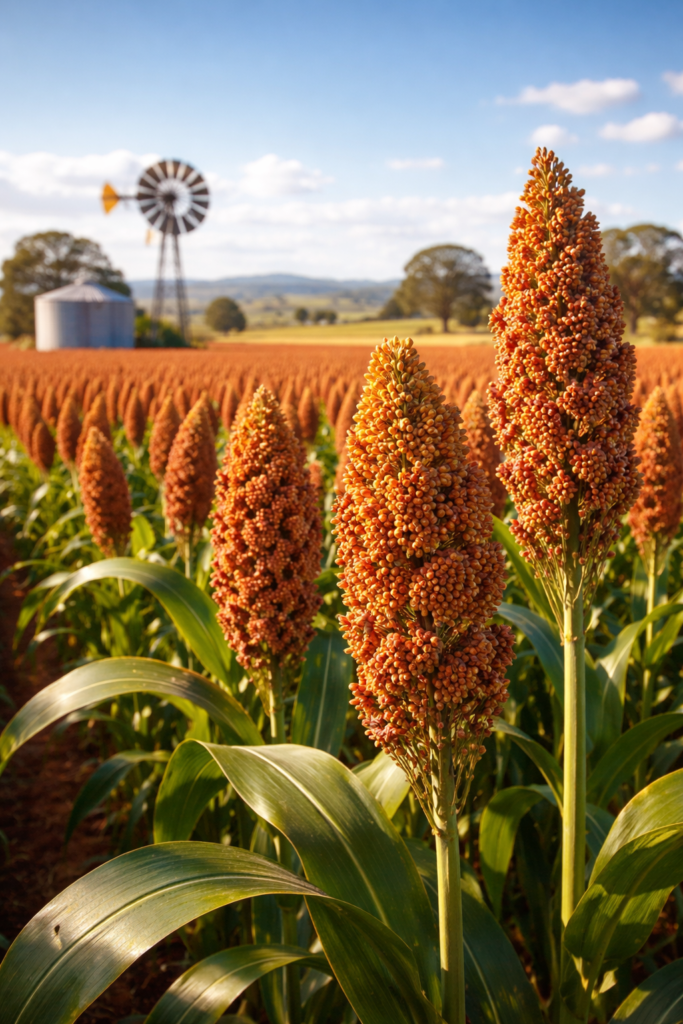
The commercial payoff arrived in 1991 when Pacific Seeds, then based in Toowoomba, released MR Buster. Bred by Neil Muller, it combined the new midge resistance with high and consistent grain yields, good grain size and strong standability. It was, by any measure, a landmark moment for Australian sorghum. MR Buster didn’t just perform well in trials—it performed well everywhere, in dryland and irrigated systems, on narrow and wide rows, across the full range of northern growing environments.
What happened next was extraordinary by crop industry standards. MR Buster became the default sorghum hybrid for an entire generation of growers. At its peak, it accounted for an estimated 40 to 50 per cent of the entire Queensland sorghum crop. Growers planted it year after year because it delivered. Research trials at the University of Queensland’s QAAFI consistently used MR Buster as the benchmark against which all other hybrids were measured. For 32 years, nothing truly displaced it.
An economic analysis conducted by Queensland Government economists estimated the return from 15 years of sorghum breeding delivered a benefit-to-cost ratio of around 17 to 1. And that figure captures only part of the story, because 100 per cent of commercial sorghum hybrids grown in Australia today carry a genetic contribution from the public pre-breeding program.
Stay-Green: Teaching Sorghum to Survive
If midge resistance was the trait that made sorghum reliable, stay-green was the trait that made it resilient. In a crop grown predominantly under dryland conditions in some of Australia’s most variable rainfall environments, the ability to keep functioning under terminal drought is not a nice-to-have—it’s a survival mechanism.
Stay-green refers to the capacity of a plant to maintain green, photosynthetically active leaves during grain fill, even as soil moisture runs out. In conventional sorghum genotypes, drought during grain fill triggers rapid leaf senescence—the plant essentially cannibalises its own foliage to fill grain, then dies. Stay-green genotypes delay this process, maintaining leaf function longer, which translates to heavier, better-filled grain and—critically—stems that remain stronger and resist lodging.
The genetic basis of stay-green in sorghum has been a major focus of the Jordan group at the University of Queensland, which identified and mapped the key genomic regions responsible for the trait. Deploying stay-green into commercial hybrids gave growers a buffer against the late-season moisture stress that is almost inevitable in dryland sorghum production across much of Queensland and northern NSW. The trait doesn’t eliminate the impact of drought, but it softens the blow—and in a crop where the difference between three tonnes and five tonnes per hectare can make or break a season’s profitability, that buffer matters enormously.
More recently, researchers have turned to unmanned aerial vehicles and machine learning to phenotype stay-green at scale across breeding trials. A 2025 study demonstrated that remote sensing via drones could efficiently assess stay-green expression across large field populations, accelerating the identification of elite lines and reducing the time and labour costs of traditional ground-based scoring. It is a glimpse of how twenty-first-century tools are being layered onto traits that were first identified decades ago.
Beyond Buster: The New Generation
The post-MR Buster era has seen a proliferation of hybrids targeting different niches within the northern cropping system. Pacific Seeds—now part of the Advanta Seeds group—released MR Bazley for tougher, drier environments, where its static yield stability meant growers could count on a floor even in poor seasons. MR Taurus offered higher yield potential with medium-quick maturity. And the company’s newer hybrids like Resolute have pushed the performance envelope further still.
QAAFI’s Associate Professor Daniel Rodriguez led a major project that characterised commercial hybrids across a range of environments yielding between three and 12 tonnes per hectare. The key finding was that matching the right hybrid to the right environment and management—what researchers call crop design—could significantly lift yields beyond what growers were achieving with a one-size-fits-all approach. High-yielding, dynamic hybrids excelled under irrigation or in wetter seasons but risked lodging. Stable hybrids traded some peak yield for consistency in tougher years. The message was clear: the era of planting MR Buster in every paddock regardless of conditions was leaving yield on the table.
Perhaps the most significant recent innovation is igrowth, a world-first herbicide tolerance technology developed by Pacific Seeds. The igrowth system uses imidazolinone-tolerant sorghum varieties—starting with Sentinel IG—to enable in-crop weed control that was previously impossible in sorghum. For growers battling summer grass weeds in sorghum paddocks, igrowth represented a step change in flexibility. The technology was developed through conventional breeding, not genetic modification, which avoided the regulatory and market access hurdles that have complicated GM crop adoption in Australia.
AI, Drones and the Next Frontier
The sorghum breeding pipeline is now being reshaped by tools that would have been science fiction when MR Buster was released. A new industry partnership, funded by GRDC and involving the University of Queensland, the Department of Agriculture and Fisheries Queensland, and Advanta Seeds, is harnessing artificial intelligence to accelerate breeding decisions. The goal is to use AI to integrate the vast datasets generated by genomic analysis, phenotyping platforms and multi-environment trials into prediction models that identify promising crosses faster and with greater accuracy than traditional methods.
Drone-based phenotyping is already operational in sorghum breeding programs, capturing canopy temperature, vegetation indices and plant height data across thousands of plots in a single flight. These high-throughput tools allow breeders to assess traits like stay-green, lodging resistance and biomass accumulation at a resolution and speed that ground-based methods simply cannot match.
The University of Queensland has also received regulatory approval for field trials of genetically modified sorghum altered for asexual reproduction—a technology called apomixis that, if successful, could allow hybrid vigour to be fixed and reproduced through seed without the need for hybrid seed production each generation. It is still early-stage research, but the implications for reducing seed costs and expanding access to elite genetics could be transformative, particularly for sorghum growers in developing countries where hybrid seed supply chains are less robust.
GRDC is also investing in research to improve lodging resistance—identifying the genetic traits that strengthen sorghum stems. As yield potential climbs and grain heads get heavier, keeping the plant upright through to harvest becomes increasingly important. It’s the kind of mundane-sounding work that rarely makes headlines but directly determines how much of the crop’s potential yield actually ends up in the bin.
A Crop That Keeps Earning Its Place
Australia’s 2025–26 sorghum crop is forecast at 2.5 million tonnes—down six per cent on the previous year, reflecting drier conditions in some southern Queensland and northern NSW regions, but still seven per cent above the five-year average. Early-harvested crops on the Darling Downs came in at five to seven tonnes per hectare where November rains hit their mark. On the Liverpool Plains, the area planted was described as close to the strong 2022 summer. China remains the dominant export destination, with sorghum heading to Newcastle and Brisbane for bulk shipment alongside a robust domestic feed market supplying the poultry, pig, beef and dairy industries.
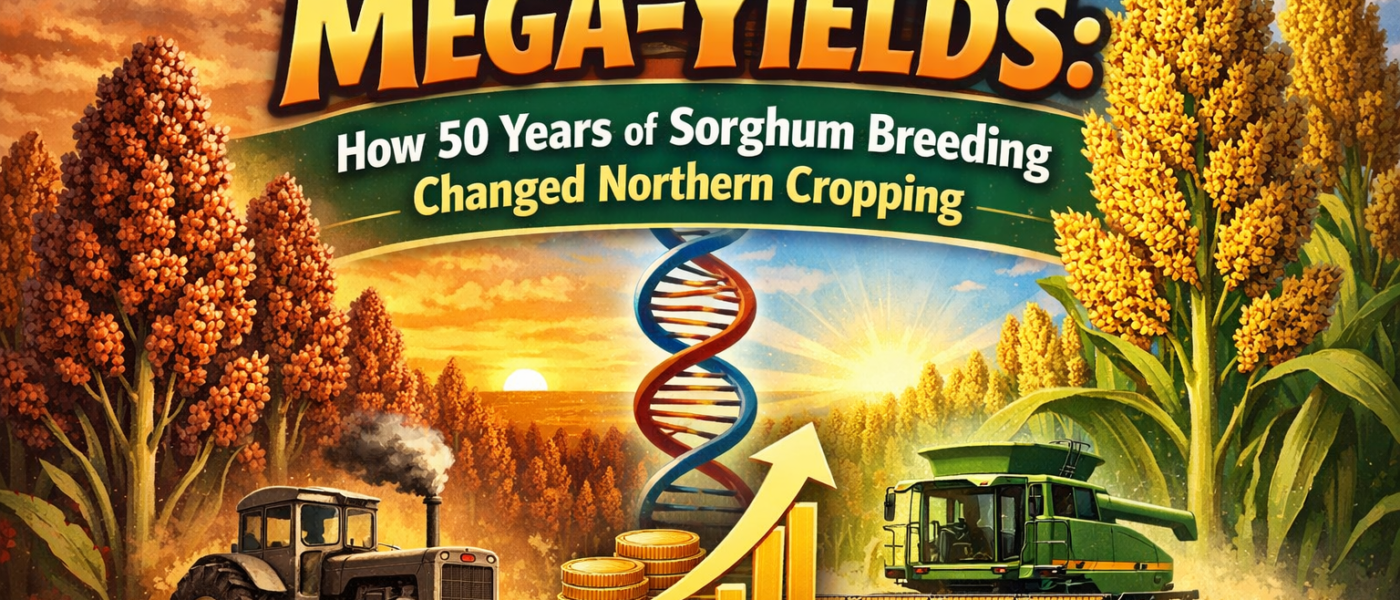
None of this would be possible without the breeding work that turned an opportunistic stock feed into a crop that can reliably deliver five-plus tonnes under favourable conditions and hold together at three tonnes when the season turns hostile. The progression from Caprock to MR Buster to igrowth to AI-assisted breeding reflects a half-century of compound gains—each generation building on the last, each breakthrough making the next one possible.
Professor David Jordan’s pre-breeding program at the University of Queensland, which has contributed germplasm to 100 per cent of commercial Australian sorghum hybrids, is currently focused on increasing genetic diversity while maintaining midge resistance and stay-green drought tolerance. The program is also working to improve resistance to sorghum ergot, enhance grain quality through the waxy gene, and diversify midge resistance mechanisms. These are long-horizon investments—the kind of work that takes a decade or more to reach a grower’s paddock.
But that has always been the nature of sorghum breeding in Australia. Patient work, compounding returns, and a crop that keeps surprising the people who grow it. The next generation of hybrids, shaped by AI and phenotyped by drones, will push yields higher and adapt the crop to a warming, more variable climate. But they will stand on the shoulders of Neil Muller, Bob Henzell, David Jordan, and the generations of researchers who saw something worth investing in when sorghum was just milo—a stockfeed nobody paid much attention to.
These days, five-tonne sorghum crops on the Downs pay for a lot of attention.