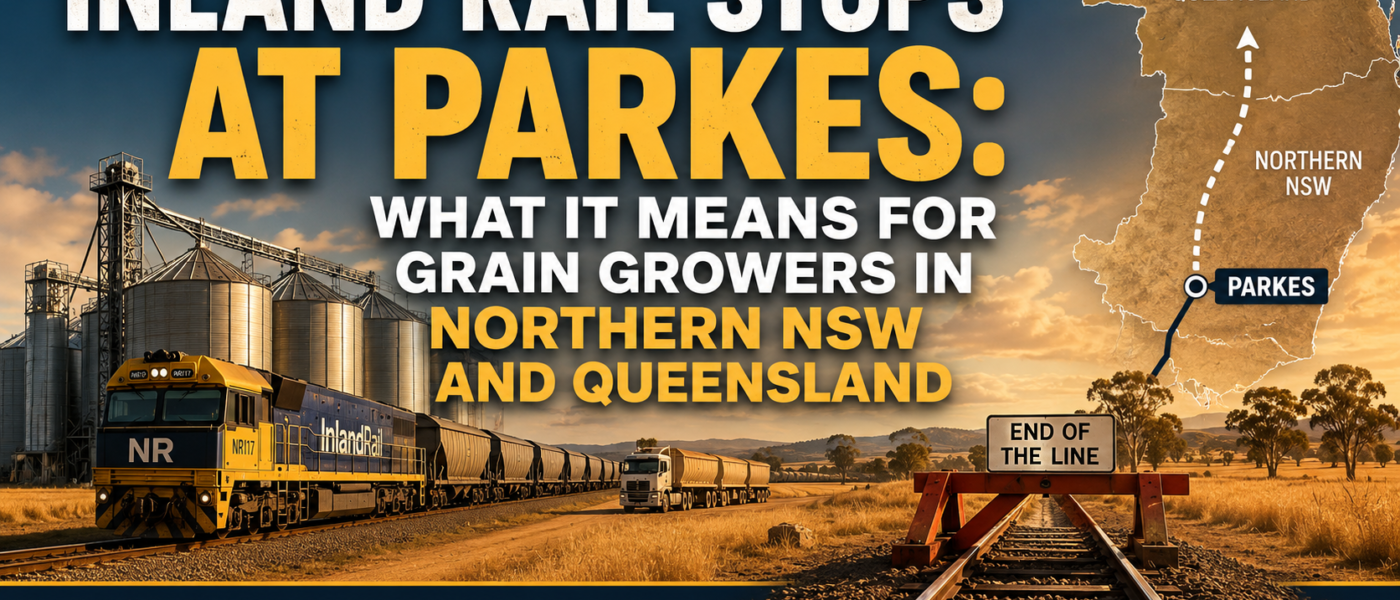

A major freight promise has just been cut short
The federal government has now confirmed that Inland Rail will be consolidated at Parkes, with construction to continue between Beveridge in Victoria and Parkes in New South Wales by the end of 2027, while works north of Parkes shift to corridor preservation and protection of future terminal sites rather than full delivery. The government says the decision followed independent cost assurance showing the full Melbourne-to-Brisbane project would now cost more than $45 billion and could not be delivered until at least 2036.
For grain growers in northern NSW and Queensland, that is a big change. The original Inland Rail vision was not just another rail project. It was meant to create a freight spine linking major agricultural regions to Brisbane and other markets with faster, more resilient rail, less reliance on road freight, and much larger train capacity. Inland Rail’s own materials say the full project was designed to connect Melbourne to Brisbane, allow double-stacked trains, cut Melbourne–Brisbane rail transit time from 33 hours to less than 24, and reduce reliance on roads.
What this does not mean
The first point to make is that this is not the same as saying rail freight disappears north of Parkes. Existing rail lines still exist, and some Inland Rail-related works in the north are already operational. Grain Central reports that the Narrabri to North Star upgrade was completed in late 2023 and that grain trains have already been using those lines independently of the broader Inland Rail build. Inland Rail’s own project information also says completed sections become part of the ARTC network and continue to be used by freight operators.
So the immediate effect is not that grain from Moree, Narrabri, Goondiwindi or the Darling Downs suddenly has nowhere to go by rail. The more accurate reading is that growers have lost, for now, the future network uplift that Inland Rail was supposed to bring: a straighter, more capable inland connection to Queensland terminals and intermodal hubs, plus a stronger alternative to road and to the more constrained existing east-coast freight routes.
Why this matters to grain growers more than it might seem
Freight is already one of the biggest structural costs in the grain game. GrainGrowers said in April 2025 that transport costs alone amount to $2.1 billion annually for Australian grain growers, and described supply chains as the lifeblood of the grains industry. In November 2025, GrainGrowers’ freight-route work also said much of the grain freight network is outdated, fragmented and vulnerable to flooding and extreme weather, with those constraints increasing costs and reducing competitiveness.
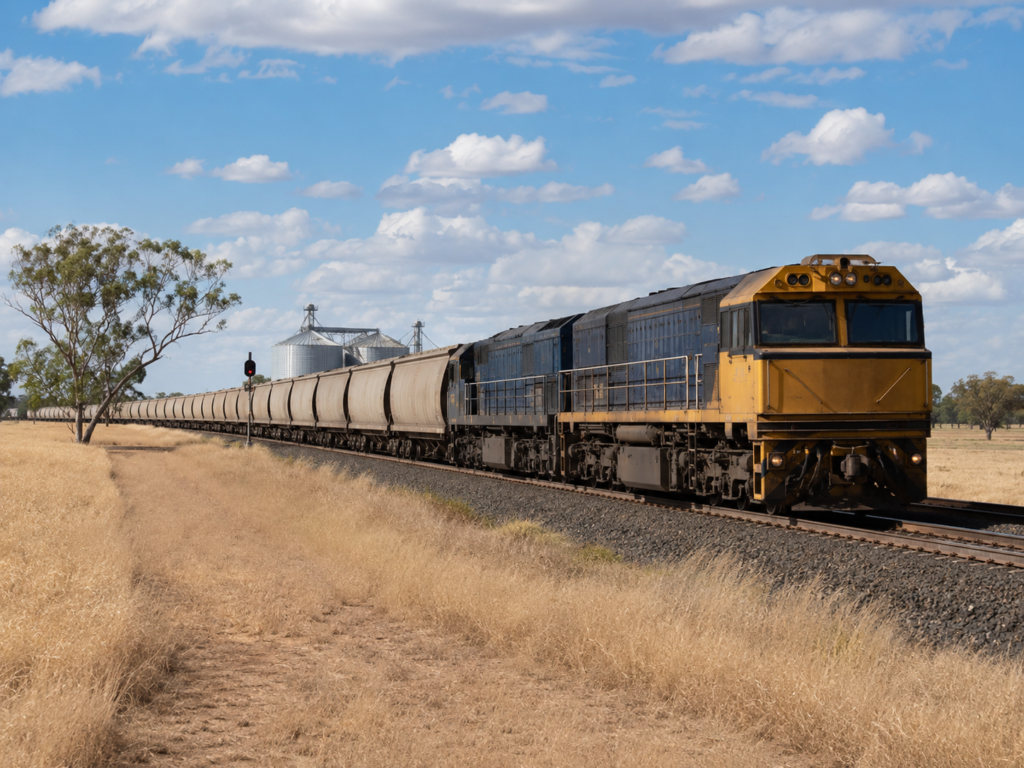
That is the real lens through which northern NSW and Queensland growers should read this decision. Inland Rail was never going to magically fix every freight problem. But it was supposed to improve the odds of moving more grain more efficiently, especially in big-crop years and on long-distance tasks. Without the northern link, growers are left leaning more heavily on the same existing road and rail systems that GrainGrowers says are already carrying bottlenecks, flood risk and access limitations.
Northern NSW growers are likely to feel the lost opportunity most in export logistics
Northern NSW grain already relies on a mix of road and rail, and GrainGrowers’ freight mapping shows just how busy that system is. It estimates more than 880,000 trailer loads are moved in NSW, with major grain routes concentrated through the grain belt, while also noting flood risk on important corridors such as the Newell Highway and PBS-network gaps that limit freight productivity. The same analysis says the average grain trip in NSW is 131km, well below the average receival-site-to-port distance of 418km, which highlights how dependent the state already is on rail to finish the longer haul to port.
For growers in places like Narrabri, Moree and the wider north-west, that means the Inland Rail cutback is likely to be felt less as an overnight shock and more as a missed long-term productivity gain. The region still has rail, and it still has operating upgraded track in parts, but the larger inland corridor that was meant to connect those northern systems more powerfully into Queensland and Brisbane-bound freight is now on ice. NSW Farmers said the decision leaves major unanswered questions for businesses north of Parkes and called for genuine freight-capacity upgrades and reinvestment into the regional network.
Queensland growers lose a major future freight option
Queensland is where the decision feels even more blunt. The official announcement says works north of Parkes will now focus only on corridor preservation and on protecting future intermodal-terminal sites in Queensland. Grain Central identified those future terminal sites as Gowrie and Ebenezer, but with no full northern build proceeding for now. ABC reported that businesses and communities in southern Queensland had been expecting Inland Rail-linked hubs including InterLinkSQ near Toowoomba and the Ebenezer inland port area near Ipswich to anchor future freight growth.
For grain growers on the Darling Downs and surrounding districts, that matters because Queensland grain freight is already highly concentrated around the western and southern Downs. GrainGrowers’ route mapping says Queensland’s dominant grain routes include the Gore, Barwon, Moonie, Leichhardt and Warrego highways plus the northern end of the Newell, with more than 325,000 trailer movements a year at an average distance of 173km. It also said Queensland’s PBS A-double network is “not fit-for-purpose,” which is another way of saying road productivity is already not where growers would want it to be.
In practical terms, that means the cancellation north of Parkes is likely to keep more pressure on road-based grain movements in southern Queensland for longer. It also pushes further into the future any serious chance of having a purpose-built inland rail option that could take some of that task off highways and into a higher-capacity corridor. That is an inference, but it is a straightforward one given Inland Rail’s stated purpose of reducing road reliance and GrainGrowers’ evidence that Queensland’s current road-freight network still has significant productivity gaps.
This is also about resilience, not just cost
One of the most overlooked parts of the Inland Rail argument was resilience. Inland Rail’s own materials say the project was meant to improve supply-chain resilience by creating an additional inland freight route and reducing dependence on more congested or disruption-prone corridors. GrainGrowers’ freight report likewise highlights climate risk, especially flooding, as a major threat to grain freight efficiency in NSW and Queensland.
That matters for grain because growers do not only need the cheapest freight pathway in a perfect season. They also need a system that still works when roads are cut, ports are congested, or crop size suddenly jumps. Losing the northern half of Inland Rail does not eliminate all resilience options, but it does remove one of the biggest proposed future buffers for the grain industry in northern NSW and Queensland.
There is one possible silver lining, but it is smaller than the original promise
The government is not walking away from freight rail investment entirely. Alongside the Parkes decision, it announced $1.75 billion for productivity, resilience and reliability upgrades on the existing ARTC freight network, plus a $55 million TRACK pilot program to encourage more freight onto rail and sea. Grain Central says that reallocated funding will go into track renewals, passing-loop extensions, signalling improvements, removal of speed restrictions and resilience upgrades on flood-prone sections of the current network.
If those upgrades are well targeted, growers in northern NSW and Queensland may still see benefits through better performance on the existing network. But that is still a different outcome from the one the full Inland Rail project promised. Upgrading what exists may help reliability; it does not deliver the same step-change as a completed Melbourne-to-Brisbane inland freight spine with dual-gauge integration into Queensland and direct connection to future terminals such as Ebenezer.
The bottom line for grain growers
For grain growers in northern NSW, this decision is mainly a blow to future freight efficiency and network optionality. For growers in Queensland, especially on and around the Darling Downs, it is also a blow to long-term hopes of a bigger rail-based freight reshaping of the region. Existing rail and road routes will keep working, and some previously completed upgrades will still matter. But the larger productivity promise north of Parkes has clearly been pushed well into the future.
The plain-English version is this: growers are unlikely to feel the full impact tomorrow morning at the farm gate, but they probably will feel it over time in the form of fewer freight options, slower progress on cost reduction, continued road pressure, and less resilience in getting grain to market. In an industry where supply-chain costs are already huge and freight bottlenecks already cut into profitability, that is a significant setback.