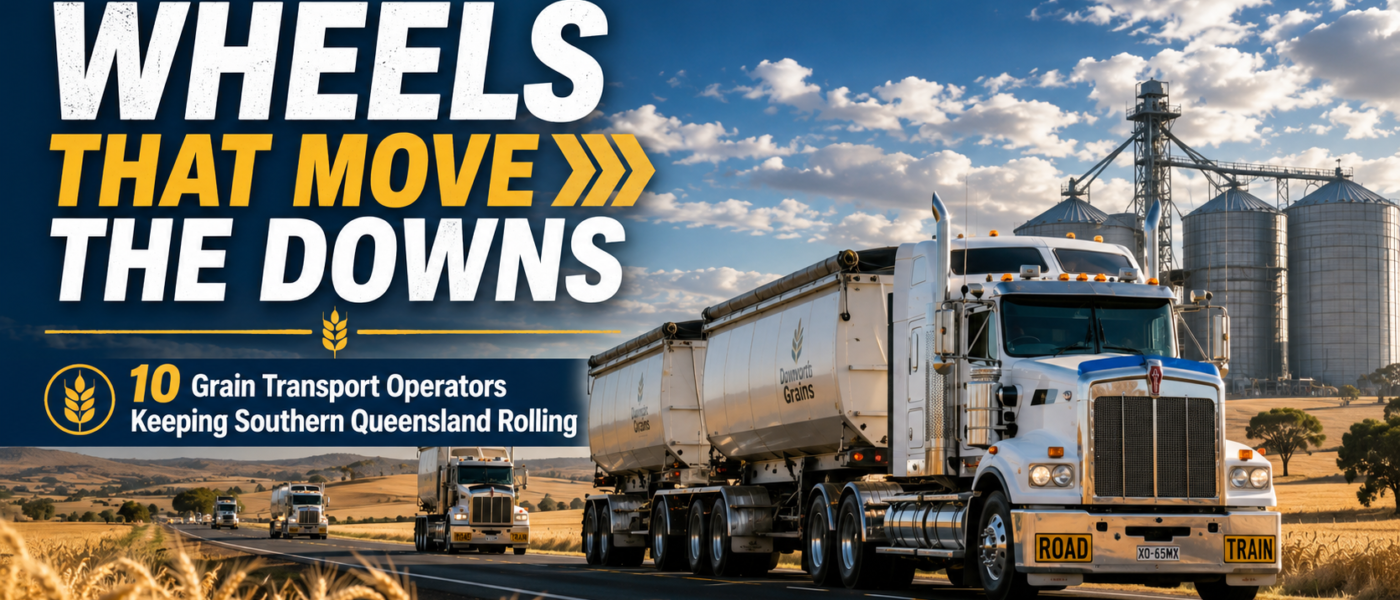

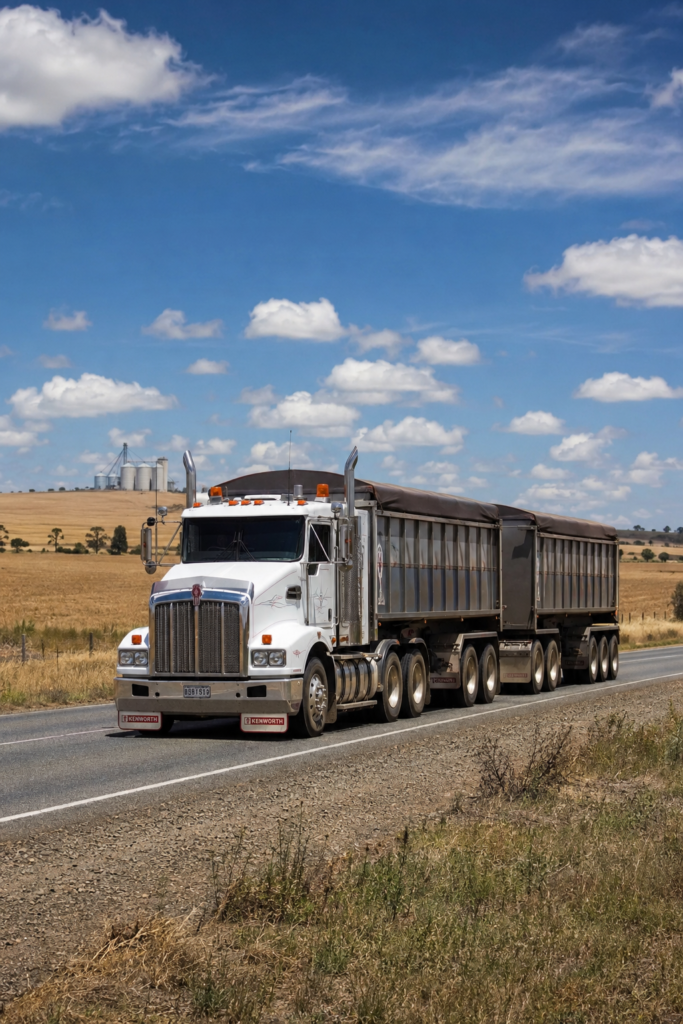
Stand at the gate of any feedlot on the Darling Downs at five in the morning and you’ll see them lining up — B-doubles, road trains, A-doubles, tip-over-axle tippers, the occasional bulk blower with its hose coiled neatly behind the cab. The trucks change. The job doesn’t. Grain has to come off the paddock, into a silo or a bunker, then onto a feedlot, a flour mill, a malthouse, a packing facility, or a port. And in southern Queensland, almost all of that movement happens by rubber meeting road.
The Darling Downs is the biggest grain-growing region in Queensland and one of the densest concentrations of cattle feedlots in the country. The combination produces a transport task that’s complicated, seasonally lumpy, and unforgiving on operators who can’t manage cost. Industry estimates have suggested up to 100 grain trucks were “parked up” or redeployed in southern Queensland during the 2024 freight slump, with rates briefly collapsing as low as 7c per kilometre per tonne — down from 22c during the 2021–2023 export boom — before consolidating back around 14–15c. That kind of volatility weeds out operators fast. The ones still on the road are the ones that have figured out how to survive it.
What follows is not a ranked top 10 — there’s no public scorecard for this stuff, and any operator will tell you the “best” carrier is the one that turned up when they said they would. Think of it instead as a tour through ten of the more notable operators servicing grain on the Downs, ranging from heavyweight family-owned fleets to specialist export packers. Many of these are direct competitors. Most of them, in true regional Queensland fashion, are also mates.
1. Ambrose Haulage (Goondiwindi)
If there’s a single name that’s become synonymous with grain haulage on the southern Downs over the past decade, it’s Ambrose. Started by Jim Ambrose in 2008 with a single truck and what was then no grain experience, the Goondiwindi-based business has grown into one of the most significant operators in the region. The fleet now sits at around 30 truck combinations, with 66 Lionel Moore trailer units including tip-over-axle tippers, drop decks, A-doubles, AB-triples and dollies — the biggest line-up in the company’s history. The operation is fully IAP (Intelligent Access Program) compliant, with all prime movers integrated with On Board Mass through the trailers.
Ambrose has also shown the operational nous that defines the better operators in this game. When the Queensland export task collapsed in 2024, 10 of their fleet was redeployed into Victoria on six-to-eight week rotations to keep trucks rolling and drivers retained. That kind of flexibility is the difference between staying in business and joining the parked-up fleet.
2. Darling Downs Haulage (Toowoomba)
The name does the geographic positioning for them. Darling Downs Haulage is a privately owned, Queensland-based logistics company specialising in excess mass and dimension freight, grain, oversize and liquid feed haulage, with a fleet of modern prime movers and an array of heavy-duty trailers. The “we cart grain Australia wide” tagline reflects the reality of modern Downs-based operators — local-focused but with the legs to chase work interstate when conditions demand it.
3. Gehrke Ag (Hatton Vale)
Sitting on the Lockyer side of the Toowoomba Range, Gehrke Ag bridges the Downs and the south-east coast. Established more than 40 years ago, Gehrke Ag now employs around 30 staff and runs a large grain storage and handling facility at Hatton Vale, with services including drying, fumigation, machine dressing and containerisation of bulk grain for export and domestic customers. They transport bulk grain from farms and depots across Queensland and northern New South Wales to domestic and export facilities, with a fleet of heavy vehicles and tippers and a network of trusted sub-contractors.
What’s notable about Gehrke is the integration — they’re not just carting grain, they’re cleaning it, drying it, fumigating it, and packing it for export. That makes them more of a logistics partner than a pure carrier, which is increasingly the model that survives in a tight-margin industry.
4. Grainhart (Oakey)
Grainhart isn’t just a transport company — it’s the closest thing the Downs has to an integrated containerised export hub. Based at Oakey on the outskirts of Toowoomba, Grainhart was established in 2005 by Managing Director Peter Hart and operates as one of Queensland’s largest cotton seed and grain packers, providing containerisation, storage and road transport with an automated containerised packing system. Their A-double container skeleton trailers can carry 20 foot and 40 foot containers to the Port of Brisbane in road train configuration, enabling loads up to 79 tonnes GVM.
The Oakey location matters. With most southern Queensland grain heading to the Port of Brisbane via the Warrego, the operators positioned along that highway have a natural geographical advantage. Grainhart has built a business model around exploiting it.
5. Western Downs Transport (Dalby)
A family-owned haulage business based in Dalby – Western Downs Transport handles cotton, grain, fertiliser and equipment heavy haulage, with the family describing themselves as supporting farming enterprises by delivering cropping inputs like manure and fertiliser as well as harvested product for processing and marketing. They’re a smaller operator than the Ambrose-scale fleets, but exactly the kind of community-anchored carrier that the western Downs grain industry runs on. When you’ve got 30,000 tonnes of sorghum sitting in a bunker outside Tara and you need it shifted before the rain, a relationship with an operator like this matters more than a sharp interstate rate card.
6. Triple A Bulk Haulage (Dalby)
Triple A Bulk Haulage is a family-owned and operated business based at 225 Yaralla Road in Dalby, offering complete logistical solutions with a diverse range of tippers, step decks, flattops, extendables, crates and chain beds. Located within the Darling Downs grain belt, their footprint allows them to freight grain from central Queensland through to northern NSW and central Victoria, handling pre-planting fertilisers through to post-harvest movements.
The variety of trailer types matters more than it sounds. A grower needing to move bagged seed, then bulk fertiliser, then a header on a low loader, then a load of harvested wheat, all over a six-month window, doesn’t want to deal with multiple operators. Triple A has built around that one-stop logic.
7. TFT Transport (Toowoomba)
A smaller but well-regarded Toowoomba-based operator, TFT Transport runs bulk grain haulage alongside general freight, including full loads from Brisbane and Toowoomba to Central Queensland, with drop deck, curtainside and open flat-top configurations. The Brisbane–Toowoomba–Central Queensland triangle is a useful corridor to play in, particularly when grain freight is soft and general freight can keep the wheels turning.
8. Weier Haulage (Dalby)
A fixture on Churchill Street in Dalby, Weier Haulage is a long-established Dalby operator running curtain siders, low loaders, road trains, side tippers, tilt trays and trailers across interstate, local and statewide work, including bulk freight. The Weier name is also stitched into harvesting and farm contracting in the area, which means they’re embedded in the grower community in a way that’s hard for outside operators to replicate.
9. W & M Doyle Transport (Dalby)
Another long-running Dalby-based carrier operating from Healy Street. W & M Doyle Transport is established in Dalby’s transport ecosystem, providing road haulage and freight forwarding services across the region. They’re not the biggest name in town, but the persistent presence of operators like Doyle is part of what makes the Dalby grain transport ecosystem work — there’s enough redundancy that a grower or trader can always find a truck when they need one.
10. Hold Bros (Dalby)
Rounding out the Dalby contingent, Hold Bros is one of the freight and transport companies operating in Dalby’s grain transport network, listed alongside Triple A, W & M Doyle, Weier, and Queensland Transport in the local business directory for the area. They represent the layer of mid-sized regional carriers that don’t generate trade-press headlines but quietly cart a substantial share of the grain that comes off the western Downs every year.
A few honourable mentions
The list above is a representative slice rather than a complete one. Bowdens Transport, also based in Dalby, plays in heavy haulage and freight including grain-adjacent work. Queensland Transport (the company, not the regulator) and Clem A & T are part of the same Dalby cluster. Eastwells Haulage was a major Redbank-based bulk operator carting plenty of Downs grain through the boom years before Mark and Robyn Eastwell decided in late 2023 to disperse most of their fleet via Ritchie Bros, with Eastwells continuing to operate as a loading agent supported by sub-contractors.
What growers and traders should actually look for
Picking a transport partner on the Downs has become more strategic than it used to be. A few things worth weighing up:
Capacity flexibility matters more than fleet size. The operators who survive the lean years are the ones who can scale up quickly when the harvest hits and find work elsewhere when it doesn’t. Ask about their interstate work and their relationships with feedlots — both are hedges against export-driven volatility.
Compliance credentials are no longer optional. IAP, On Board Mass, fatigue management, mass management and maintenance management aren’t just acronyms — they determine which roads a truck can legally use and what tonnage it can carry. The bigger operators have invested heavily in this because the productivity gains are substantial.
Relationships still trump spot rates. The freight market on the Downs is largely an “ad hoc” market rather than a contract market. The operators who get the call first are the ones who showed up reliably last time and can be relied on to turn up every time when required.
The Darling Downs grain transport sector is one of the better examples of how regional Queensland businesses scale: family-owned, paddock-savvy, and quietly more sophisticated than the rest of the country sometimes gives them credit for. The rates may be tight, the seasons unforgiving, and the export task wildly variable — but the trucks keep rolling, and a remarkable amount of Australia’s protein supply chain ultimately depends on them doing exactly that.