
On a wet Monday morning in late February, the Indian Pacific was turned around somewhere west of Kalgoorlie and sent back to Perth. The Trans-Australian Railway — the 1,693-kilometre line that spans Australia’s normally driest and most isolated terrain across the Nullarbor to link Perth to the east coast — had been cut by floodwaters again, for the third time in four years. Track washaways of up to 100 metres were reported between McLeay and Bookaloo, north-west of Port Augusta. Three scheduled passenger trips were cancelled. A long list of freight contracts joined them.
Two weeks later, after ARTC crews had rebuilt the washaways, a second flood event cut the line in five fresh spots, including sections between Ooldea and Watson in the remote Nullarbor. Crews who had just finished the first emergency repair packed up and started the second.
If you want a physical metaphor for the state of Australian grain logistics, you can’t do much better than a line of engineers standing in knee-deep water on the Nullarbor, watching their own repair work disappear.
The grain industry has been warning about its logistics infrastructure for the better part of a decade. Successive governments have promised to fix it. A $31 billion project has been launched, reviewed, scaled back, and delayed. Bulk handlers have added port capacity while rail capacity has frayed. And the fundamental gap between Western Australia’s efficient, integrated supply chain and the east coast’s fragmented one keeps widening. This is the industry’s quiet crisis, and it’s reaching the point where quiet no longer describes it.
The east-west corridor: the canary nobody’s listening to
Start with the Trans-Australian Railway, because it’s the simplest story. The line carries a large share of domestic freight into WA, including grain moving between states for processing and stockfeed, and it sits on a single-track corridor with no alternative route. Similar damage cut the crucial line in 2022, again in 2024, and now twice in early 2026.
ARTC hasn’t been idle about this. A $1 billion Network Investment Program — jointly funded by the Australian Government and ARTC — has been rolling out upgrades to mitigate flood risk and boost the resilience and reliability of the rail network, and a package of culvert upgrades in remote SA to improve drainage along key sections of rail line was completed during a shutdown only weeks before the February closure. That’s not nothing.
The problem is scale. The line runs through 1,693 kilometres of very sparsely populated terrain, and a “once in 100-year” rainfall event in one part of it will always shut the whole thing. It can take days and even weeks for works crews to travel to the isolated areas to even report on the scale of the damage, and then weeks more to transport machinery and people to those areas for emergency repairs. That’s not a fixable engineering problem in a climate that’s delivering more of these events more often. It’s a strategic exposure the industry has collectively decided to live with, because the alternatives — truck-only freight across the Nullarbor, or building redundancy into the corridor — are either impossible or impossibly expensive.
For grain specifically, the east-west line isn’t the main artery (most WA grain goes out through Kwinana, Geraldton, Albany and Esperance). But it matters for domestic movement, for inputs coming in, and — most importantly — as a signal. If we can’t keep the most strategically vital rail corridor in the country open during the wet season, what does that say about our ability to handle a record harvest on the east coast during peak shipping?
Inland Rail: the project that was supposed to change everything
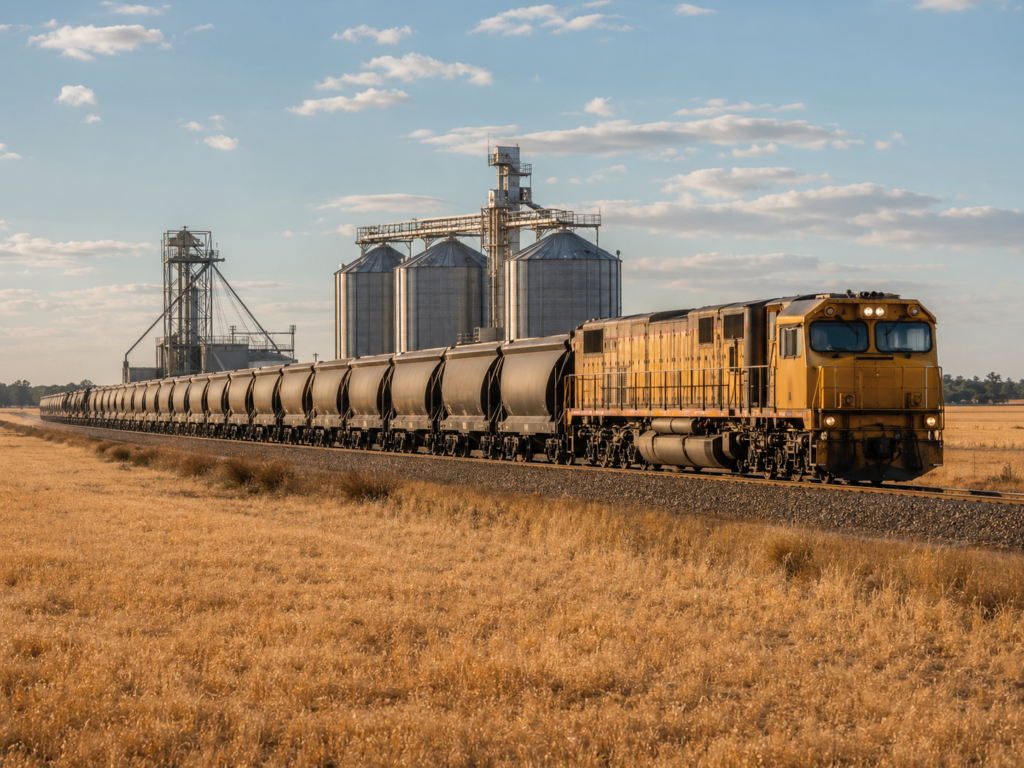
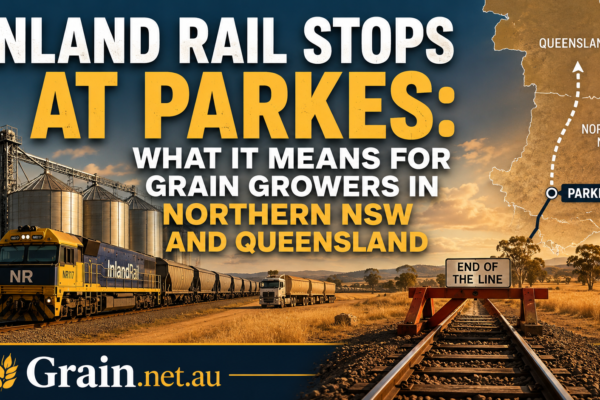
Now the big one. Inland Rail was pitched as the single most important infrastructure investment in grain logistics in a generation. A 1,600-kilometre freight corridor linking Melbourne to Brisbane via regional Victoria, NSW and Queensland, designed for double-stacked trains, cutting a projected $10 per tonne from freight costs for farmers and shifting around 200,000 trucks a year off the highways. The economic case was sound. The need was obvious.
Nearly two decades after the idea was seriously revived, here’s where it actually is. The original 2017 cost estimate was around $9.3 billion. A 2023 independent review by Dr Kerry Schott found the project had blown out to $31.4 billion. In response, the government scaled the scope back to focus on finishing the section from Melbourne to central western NSW (Beveridge to Parkes) by 2027, and deferred the portion up to Brisbane.
As of November 2025, 100% of the 1,600km alignment is in one of the following stages: environmental approval and community consultation; design refinement; construction; or operations. Some sections are operating — Stockinbingal to Parkes, Parkes to Narromine and Narrabri to North Star Phase 1 in NSW, plus four Beveridge to Albury Tranche 1 sites in Victoria, are complete and trains are running. Construction on the Illabo to Stockinbingal sections began in early 2026.
That’s real progress, and it deserves some credit. But the project’s whole original point — a continuous double-stacked corridor linking Melbourne to Brisbane — has been indefinitely deferred north of Narromine. Future decisions on the delivery of sections north of Narromine in NSW are a matter for consideration by the Australian Government and are also dependent on Inland Rail achieving environmental approvals and securing land required for the project. Translation: no-one knows when, or if, it finishes.
For northern NSW and Queensland grain growers, this is a big problem. The grain they produce still has to get to port via the existing, congested, narrow-gauge infrastructure that Inland Rail was supposed to replace. The freight cost saving doesn’t arrive. The modal shift from trucks to rail doesn’t happen. The Brisbane port terminal doesn’t get its double-stacked feeder line.
Inland Rail is not a failed project — it’s delivering where it’s being built — but it has been comprehensively de-scoped from what the grain industry was sold. Saying that out loud is important, because the political rhetoric is still pretending otherwise.
The two-speed reality: WA versus the rest
Here’s where the uncomfortable comparison comes in. Western Australia has, by any reasonable measure, the most efficient grain supply chain in the country.
CBH — Australia’s largest cooperative — had total grain receivals of 24.1 million tonnes in 2025-26, with a record 16.3 million tonnes stored under tarp in open bulkheads, surpassing the previous 14.9 million tonne mark set in 2022-23. In December 2025 alone, more than 2 million tonnes were shipped through all four of CBH’s port terminals — the second-highest monthly total on record. The cooperative structure, the integrated upcountry-to-port network, the single operating system — it all just works.
Contrast that with the east coast, where GrainCorp operates more than 150 regional receival sites with 20 million tonnes of storage capacity and up to 15 million tonnes of elevation capacity across seven bulk port terminals, but has to share rail access with coal, share port slots with multiple competing exporters, and manage a network that was never designed as a single cohesive system. Viterra runs South Australia on a different model again. Smaller operators like T-Ports, Riordans, and Qube have added capacity at the margins, but the fundamental architecture remains fragmented.
One number tells the story. In 2024-25, the big three bulk handlers — GrainCorp, Viterra and CBH — recorded at least 3.7 million tonnes of unallocated loading capacity across 17 port terminals. In other words, the ports aren’t the bottleneck. The rail network feeding them is.
That’s worth repeating because it gets the wrong end of the stick in public debate. When commentators complain about “port capacity”, they’re usually wrong. The issue is getting grain from the silo to the ship — and on the east coast, that increasingly means either sharing an over-subscribed rail network with coal trains, or putting it on a truck.
What happens next — and what should
A few things are worth saying plainly.
First, the bumper harvests are not going away. The productivity story running through Australian cropping — better varieties, better moisture management, bigger average yields — means that the industry should be budgeting for 60 Mt-plus winter crops as a new normal rather than an occasional windfall. If the logistics system is strained now, it will be strained more often.
Second, the east-coast-versus-WA gap is widening, not narrowing. WA keeps investing in its supply chain because the CBH cooperative structure forces reinvestment. The east coast keeps muddling through because no single entity has both the incentive and the capacity to fix the systemic issues. This is not a criticism of GrainCorp, which has done impressive work within its scope — it’s a structural observation about what happens when bulk handling, rail access, and port operations are split across multiple owners with competing interests.
Third, the government has been given a decade of warnings and has largely failed to respond at the necessary scale. Inland Rail’s descope is the headline, but it’s not the only example. The east-west corridor’s repeated failures should be triggering a serious conversation about redundancy and climate resilience. The rail-vs-road split for grain is still too heavily tilted toward road, with all the cost, safety, and carbon implications that carries. The grain industry is not a lobby that the big parties fear, and it shows in the policy outcomes.
The quiet part, which increasingly isn’t quiet, is that Australian grain is globally competitive on production and increasingly less competitive on delivery. We grow the stuff well and struggle to get it to the ship. For a country that built its export economy on shipping bulk commodities to the world, that’s a remarkable and avoidable failure.
The next major flood event on the east-west line will get reported as a weather story. It isn’t. It’s an infrastructure story, and it’s been an infrastructure story for years.