
Ask a grain grower what determines their profitability and you’ll hear about rainfall, input costs, commodity prices, the Australian dollar. Ask them about the supply chain—the sprawling, industrial-scale system of silos, rail lines, road trains, port terminals and ships that carries their grain from the paddock to a flour mill in Jakarta or a feedlot in Riyadh—and you’ll often get a shrug. It’s just there. It works, mostly. You deliver to the receival site, nominate your grain, and eventually it ends up on a boat.
But here’s the thing: supply chain costs for Australian wheat travelling 200 kilometres from farm to port start at $60 to $75 per tonne. In many years, that’s the single largest cost item on a grain producer’s budget—bigger than seed, bigger than fertiliser, bigger than crop protection. And unlike the weather, the supply chain is something that can be engineered, invested in and improved. Or neglected, under-invested and allowed to erode competitiveness year by year.
This is the story of how Australian grain gets from the paddock to the world—and why the journey matters as much as the crop itself.
Step One: The Receival Site
The grain supply chain begins at harvest, when a grower’s truck or road train pulls into a receival site. Australia has roughly 623 bulk handling sites scattered across the grainbelt, operated by three dominant companies: CBH Group in Western Australia, Viterra (owned by Glencore) in South Australia, and GrainCorp across the eastern states of Queensland, NSW and Victoria. Combined with an estimated 15 million tonnes of on-farm storage, the system has capacity to hold the equivalent of two years’ average grain production—around 70 million tonnes in total.
At the receival point, grain is sampled, weighed, graded and classified. This is where quality becomes dollars. A wheat load that makes Australian Hard 2 grade is worth significantly more than one downgraded to Australian Standard White. Screenings, protein, moisture, falling number, test weight—the sample hut is where the grower’s year gets its report card. GrainCorp’s Croptimiser system allows eligible loads to be blended up to higher grades, extracting value that would otherwise be lost. CBH’s network uses a similar optimisation approach, and the cooperative’s 2025–26 season saw innovations like the Avoca automated grain sampling machine deployed at upgraded sites like Corrigin.
The efficiency of this first step varies enormously. In a big harvest year, truck queues at receival sites can stretch for hours. CBH handled 24.1 million tonnes through its WA network in 2025–26, with a record 16.3 million tonnes stored under tarp in open bulkheads—gravel pads with steel frames and industrial tarps that are the unglamorous but essential overflow when permanent storage fills up. Site upgrades under WA’s Agricultural Supply Chain Improvements program have doubled sample hut capacity at key sites, added new weighbridges and extended rail sidings, all aimed at reducing cycle times and getting grain off the grower’s truck faster.
Step Two: Upcountry to Port
Once received, grain needs to travel to port. This is where the real cost pressure lives. In Australia, grain moves by rail or road, and the economics of each mode depend on distance, volume, infrastructure quality and time of year.
Rail is the backbone for long-haul grain freight, particularly in WA and SA where the distances are vast and the volumes concentrated. CBH coordinates rail movements across WA’s four port zones, and the ASCI program has invested in longer rail sidings, faster loading facilities and upgraded tracks to move more grain per train. At Cranbrook in WA’s south-west, a new fixed rail loading facility cut the time to load a 60-wagon train from roughly seven hours to four. On the Midland Line between Carnamah and Mingenew, upgrades will allow 25 per cent more grain to be loaded per wagon for transport to the Port of Geraldton.
In eastern Australia, the picture is more fragmented. GrainCorp operates across a rail network that includes the NSW Country Regional Network—more than 2,300 kilometres of operational track, much of it aging and in need of investment. An independent freight reform panel in NSW highlighted that rail operators had described service levels on parts of the network as unacceptable. The panel called for better collaboration between NSW, Queensland and Victoria on the grain haulage task, and investigations into where rail infrastructure investment is most needed.
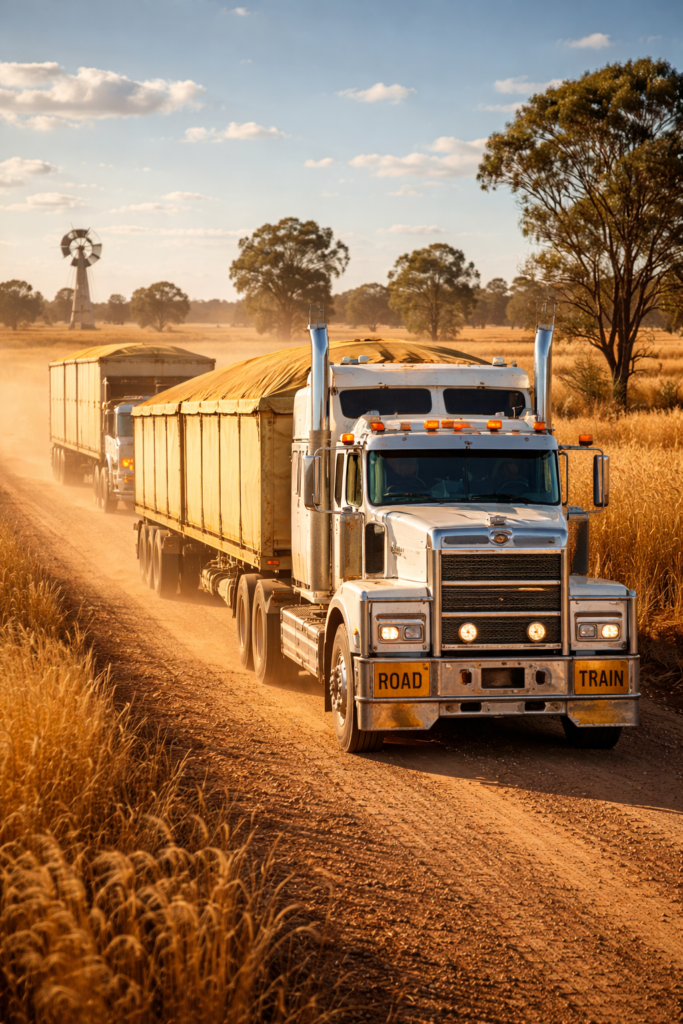
Road freight fills the gaps where rail is unavailable, uneconomic or unreliable. Trucking from farm to upcountry receival costs approximately 13.5 cents per tonne-kilometre, which adds up quickly over long distances. In regions where Tier 3 rail lines have been mothballed—such as parts of WA’s eastern wheatbelt—road has become the default, shifting costs onto growers and local road networks that were never designed for heavy grain haulage. The WA Government is investigating potential recommissioning of Tier 3 lines in the Narrogin-Wickepin-Kulin area, but restoring closed rail is expensive and the economics are contested.
The trend towards on-farm storage adds another dimension. More eastern Australian growers are investing in silos on their properties, allowing them to bypass congested receival sites at harvest, sell direct to local buyers, and time their deliveries to capture better prices. An estimated 15 million tonnes of on-farm storage now exists nationally, and that figure is growing. For the bulk handlers, on-farm storage both eases harvest pressure and fragments the throughput that makes their upcountry sites economic.
Step Three: The Port
Australia’s grain export ports are the choke point where the inland supply chain meets the global shipping market. GrainCorp operates seven bulk terminals on the east coast, with 15 million tonnes of elevation capacity. CBH runs four port terminals in WA—Kwinana, Albany, Esperance and Geraldton—and shipped more than two million tonnes through them in December 2025 alone, the second-highest monthly total on record. Viterra’s SA port network handles roughly 80 per cent of the state’s grain.
Port fees have risen faster than storage and freight fees in recent years, and represent a growing share of total supply chain costs. Loading rates, berth availability, vessel scheduling and fumigation requirements all affect how quickly grain can move from terminal to vessel. A GRDC-funded benchmarking study found that Australian port charges are generally higher on a unit-cost basis than key competitors, though WA’s streamlined, export-focused supply chain performs better than the more complex eastern states network.
The timing of port operations matters enormously. Australia’s competitive advantage in Asian grain markets is strongest in the December-to-May window, when southern hemisphere supply is fresh and northern hemisphere competitors are between harvests. Getting grain to port and onto ships during this peak period can capture premiums that disappear later in the year. This is why rail upgrades that shave hours off loading times, and port investments that increase throughput, have an outsized impact on the value growers ultimately receive.
In a big crop year like 2025–26, when wheat, barley and canola all need to move through the same port infrastructure simultaneously, the competition for shipping slots becomes intense. S&P Global noted that canola and barley exports from WA were consuming capacity that might otherwise go to wheat, making Australian wheat less price-competitive in Southeast Asian markets. The supply chain doesn’t just move grain—it allocates opportunity, and the crops that move first often capture the best returns.
Step Four: Ocean Freight
Once loaded, a Panamax or Supramax vessel carrying 50,000 to 80,000 tonnes of Australian grain typically takes seven to ten days to reach Southeast Asian destinations like Indonesia or the Philippines, and around two weeks to reach Japan or South Korea. GrainCorp alone charters more than 75 deep-sea vessels each year to move three million tonnes of grain and oilseeds to more than 50 countries and 350 customers worldwide.
Australia enjoys a natural freight advantage into its core Asian markets. The sailing distance from Kwinana to Jakarta is a fraction of what a vessel from the US Gulf or Argentina’s Up-River ports must travel to reach the same customer. This geographic edge is one reason Australian grain remains competitive in Southeast Asia even when headline prices are higher than Black Sea or South American alternatives.
But ocean freight is the stage of the supply chain most exposed to global disruption. The 2026 Middle East conflict demonstrated this brutally: the closure of the Strait of Hormuz triggered emergency surcharges of $800 per container from major carriers, rerouting via the Cape of Good Hope added 14 days to voyage times, and MSC declared an end of voyage for all shipments bound for Arabian Gulf ports. War risk insurance premiums surged. For Australian grain exporters shipping barley to Saudi Arabia or wheat to Middle Eastern millers, costs climbed overnight with no corresponding increase in the price the buyer was willing to pay.
Even without a war, ocean freight rates are volatile, driven by bunker fuel costs, vessel availability, seasonal demand and the ebb and flow of global trade. A grower in the Mallee has no control over any of it. But the cost of getting a tonne of wheat from Portland to Port Klang is as real a deduction from the farm gate return as any receival fee or rail charge.
The Competitiveness Question
When all the links in the chain are added together—receival, upcountry storage, rail or road freight, port handling, ocean shipping—supply chain costs represent roughly 30 to 40 per cent of the total delivered cost of Australian grain into Asian markets. In WA, where CBH’s vertically integrated cooperative model creates efficiencies, the supply chain accounts for about 36 per cent of delivered cost. In eastern Australia, where the network is more fragmented and rail infrastructure less reliable, the figure is higher.
By comparison, mining companies that control their infrastructure from pit to port can achieve freight and logistics costs as low as a quarter of what grain pays. It is not a fair comparison—mining moves far greater volumes along fixed corridors—but it illustrates how much room for improvement exists in the grain supply chain. Every dollar saved per tonne in logistics is a dollar that flows back to the grower, or a dollar of competitiveness gained against Argentina, Canada, Russia and Ukraine in the markets that matter.
The $31 billion Inland Rail project, currently under construction between Melbourne and Brisbane, promises to shift roughly two million tonnes of agricultural cargo from road to rail each year, cutting transit times and reducing the cost burden on highways. Completed sections like Parkes-to-Narromine are already operational, and the Illabo-to-Stockinbingal link is expected to start major construction in 2026. Whether Inland Rail delivers transformational change for grain—or remains primarily a container freight corridor that grain tangentially benefits from—is still an open question, but the directional intent is clear: more rail, less road, faster port access.
The Chain That Pays the Bills
Australian grain growers are world-class at producing grain. Decades of investment in plant breeding, agronomy, precision agriculture and risk management have made Australian crops consistently competitive on quality and yield. But growing the grain is only half the job. Moving it—reliably, affordably, and in time to capture the best available markets—is the other half, and it receives a fraction of the public attention.
The supply chain is not glamorous. It is silos under tarp, rail sidings being extended by 200 metres, sample huts being doubled from two stations to four, weighbridges being widened, fumigation protocols being tightened. It is the gravel pad at a CBH site holding 16 million tonnes of WA’s record harvest. It is a GrainCorp train running overnight from Moree to Newcastle. It is a Panamax vessel loading barley at Kwinana for a customer in Riyadh who needs it before Ramadan.
None of it happens by accident. And in a year when the Middle East conflict has disrupted shipping lanes, when a record WA crop is straining port capacity, and when NSW’s regional rail network is being reviewed for the first time in years, the supply chain has never been more visible—or more important.
From silo to ship, every link in the chain either adds value or takes it away. For Australian grain’s global competitiveness, the difference between the two is measured in dollars per tonne. And dollars per tonne is the language every grower speaks.