
Australia’s grain and pulse supply chain looks simple from a distance: grow the crop, harvest it, move it, sell it, ship it. In reality, it is a tightly linked system where agronomy, classification, storage, freight, marketing, port logistics and export compliance all have to line up. When it works well, grain flows smoothly from farm to domestic users or export vessels. When one link gets congested, the effects can be felt right across the chain. That matters in a country where grains, oilseeds and pulses have been one of the fastest-growing agricultural export categories over the past two decades, and where recent winter crop production has remained near record levels.
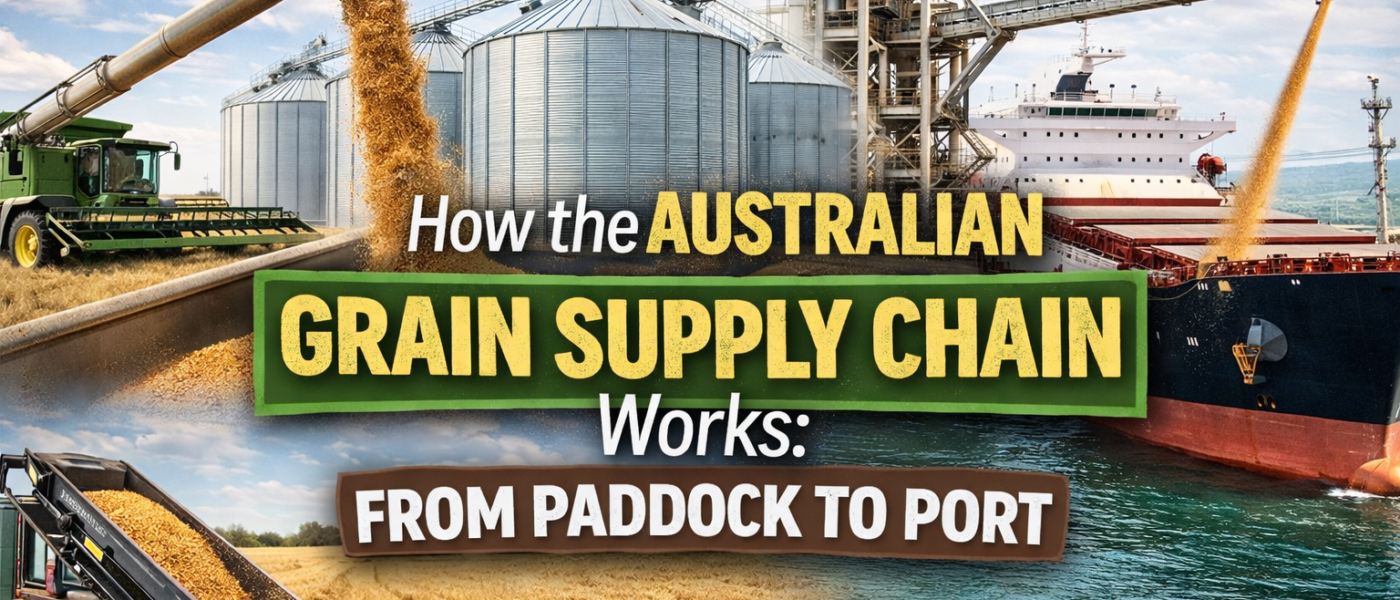
The best way to understand the Australian grain industry is to follow the crop from the paddock to its end market. Once you do that, the role of receival sites, storage operators, rail systems, road freight, ports, traders, exporters and processors becomes much clearer.
It starts in the paddock, but the supply chain really starts before sowing
Long before the header enters the paddock, growers are making supply-chain decisions. Variety choice is not just an agronomic decision; it is also a market decision. In Australia, grain classification systems are designed to align varieties with end-user demand, and Grains Australia says it maintains varietal classification systems so grain can meet market requirements and build value through that alignment. For wheat in particular, post-harvest compliance with GTA standards depends on measured quality factors such as protein, moisture, test weight, screenings, contaminants and defects.
That means the grain supply chain starts with questions like these: Is this wheat aimed at a premium milling market or a feed slot? Is this barley likely to make malt, or is it more realistically feed? Is the pulse crop being grown for a specific human-consumption export market? Those decisions shape everything that follows, including segregation, storage strategy, transport timing and sales pathway. For pulses, that market focus is especially important because Australia’s pulse sector is heavily export-oriented; Grains Australia says pulses are now mainstream, Australia produces roughly 2 to 4.5 million tonnes a year, and around 90% of production is exported.

Harvest is where physical logistics begin
Once harvest starts, the supply chain becomes physical rather than theoretical. Grain comes off the header and has to go somewhere quickly, safely and in the right condition. In broad terms, there are three immediate pathways: straight into on-farm storage, direct to a bulk handler receival site, or direct to a domestic buyer, processor or container packer if the commercial arrangements and logistics are already in place.
This is the point where timing, moisture, truck availability and harvest pressure all collide. A grower may want to move grain straight off farm, but that depends on truck access, site queues, opening hours, segregation availability and whether the grain meets the specification required at delivery. Equally, on-farm storage can provide flexibility, but only if it is managed properly. GRDC notes that freight can cost more at harvest because demand is high and receival queues are long, and that holding grain on farm for later movement can create a financial benefit through cheaper post-harvest freight or a direct movement to port that avoids some local bulk handler charges.
Receival sites are the first major control point
For a lot of Australian grain, the first major supply-chain checkpoint is the receival site. These sites are where grain is weighed, sampled, tested, classified and segregated. This part of the chain is absolutely central because once grain enters the network, it needs to be identified and managed in a way that protects both value and market access.
On the east coast, GrainCorp says it operates more than 150 regional receival sites and seven bulk port terminals, with a network that connects more than 10,000 growers to over 1,000 end-market customers across food, beverage, edible oils and animal feed industries. That gives a good sense of the scale involved in moving grain from inland regions into domestic and export channels.
At receival, the testing and classification process is not just paperwork. It determines the grain’s commercial identity. For wheat, GTA standards require measurement of protein, moisture, test weight and screenings, along with minimum acceptable limits for contaminants and defects, with compliance based on post-harvest testing. In practical terms, that classification result affects the segregation the grain can enter, the markets it can access and the price it can achieve.
Storage is not just “holding grain” — it is value preservation
After receival, grain may sit in a bunker, upright silo, shed, grain bag or other storage system depending on the operator, region and time of year. The key point is that storage is not passive. The grain has to be preserved in a saleable condition. That means attention to moisture, temperature, insects, hygiene, fumigation discipline, segregation integrity and traceability.
Grain Trade Australia’s Code of Practice describes itself as a practical guide for participants in the grain industry to achieve the standards and expectations of domestic and export customers, and it specifically highlights the importance of effective assessment, classification, storage and transport. It also points to supporting guidance on sampling, testing, storage and transport practices. That tells you something important about the Australian industry: the supply chain is built around preserving quality, not just shifting tonnage.
This is where a lot of supply-chain value can be won or lost. Grain that is kept cool, dry, clean and correctly segregated remains marketable. Grain that is poorly stored can drift out of spec, pick up insects, lose quality or create market-access problems. In other words, the storage phase is where the industry protects the value created in the paddock.
Inland freight is one of the biggest make-or-break links
Once grain is accumulated, it has to move inland toward a processor, feedlot, crusher, maltster, flour mill, container packer or export terminal. In Australia, that usually means road, rail, or a combination of both. This is one of the most important cost and efficiency points in the whole chain.
GrainCorp says it manages logistics across bulk storage, rail networks, road freight and ports, including time-slotting and quality control protocols aimed at improving turnaround efficiency. In Western Australia, CBH provides an even clearer picture of scale: it says it owns 28 locomotives and 574 wagons moving grain from upcountry sites to Geraldton, Kwinana and Albany, with about 2,800 trains arriving at those ports each year and delivering 7.6 million tonnes of grain on average.
That inland task is where geography really bites. Australia grows grain a long way from port in many regions. Every tonne has to be assembled, loaded, moved, unloaded and scheduled into a downstream pathway. If rail is short, road has to do more. If roads are under pressure, harvest slows. If port capacity is full, grain can back up inland. The whole system behaves like a chain of linked reservoirs: one bottleneck affects everything upstream.
Not all grain goes to export
A lot of people outside the industry think Australian grain simply goes overseas, but the domestic market is an important part of the supply chain. Grain and oilseeds also move into flour mills, feed mills, livestock sectors, maltsters, oilseed crushers and food manufacturers. GrainCorp’s network description alone points to major domestic demand in food, beverage, edible oils and animal feed.
This domestic-versus-export split matters because it changes the logistics task. Domestic supply chains are often smaller-parcel, shorter-haul and more specification-specific. Export pathways are more about building large, uniform parcels efficiently and meeting importing-country requirements. In a strong crop year, both pathways can be busy at once. That is when the industry really earns its keep.
Ports are where logistics and marketing finally meet
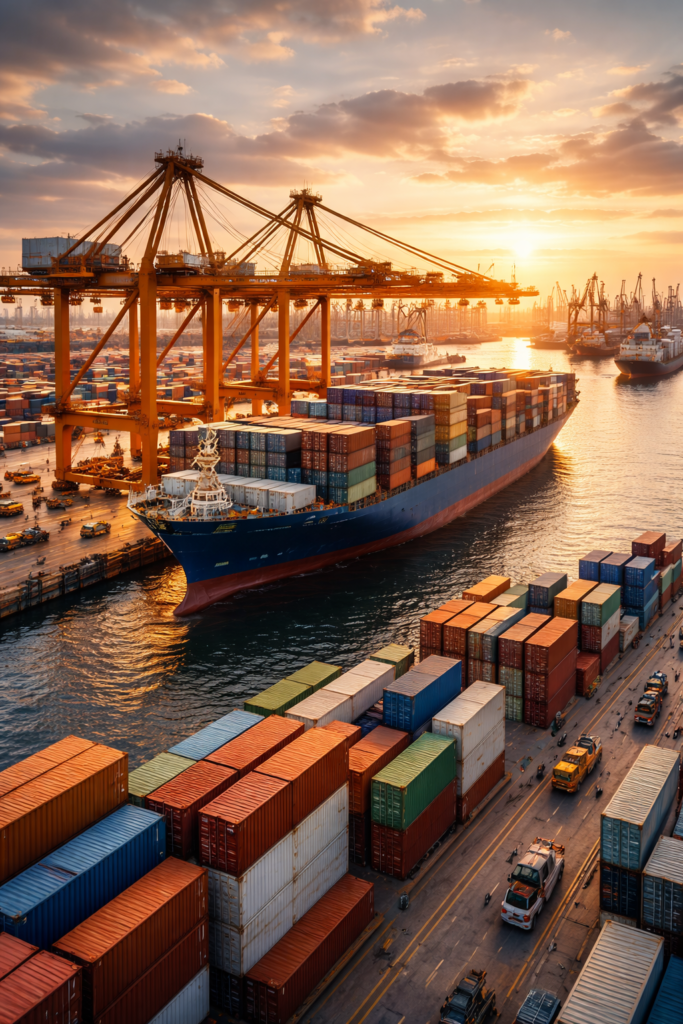
The port is the point where all the upstream work becomes a shipment. But port logistics are not just about loading a ship. Before grain reaches the vessel, there has already been a long process of accumulation, blending, stock allocation, freight planning, vessel scheduling and documentation.
On the east coast, GrainCorp’s network links inland receival sites to seven bulk port terminals. In WA, CBH’s system links upcountry receival points to export terminals through a dedicated rail fleet. Those are good examples of why ports matter so much: they are not stand-alone assets, but the downstream end of much larger storage-and-handling systems.
There is also a separate containerised export pathway, which is especially relevant for some pulse and specialty grain trades. GRDC notes that Australia’s container operations are concentrated in the ports of Botany, Melbourne, Brisbane, Fremantle and Adelaide, and that many companies are involved in containerised grain exports through those hubs. That pathway can suit markets needing smaller parcels, specialist specifications or more flexible shipment programs than bulk vessels allow.
Export grain must satisfy more than just commercial specs
Once grain is heading into export, compliance becomes even more important. Commercial quality is one layer, but export certification and phytosanitary requirements are another. The Department of Agriculture, Fisheries and Forestry’s export process instructions for prescribed grain and plant products show how seriously this is treated: pests, contaminants and weed seeds found during inspection must be recorded, and where export validity needs extension, the client must provide assurance that the phytosanitary status of the goods has not changed since inspection.
That is why the phrase “from paddock to port” really means more than transport. It includes paddock decisions, receival classification, storage discipline, traceability, freight execution, export documentation and market-access compliance. A shipment can fail commercially, operationally or regulatorily if any of those steps are mishandled.
Why pulses deserve their own mention
Pulses run through the same broad supply chain logic, but they often have their own market nuances. Grains Australia says pulses include lentils, faba beans, mungbeans, field peas, chickpeas and lupins, and notes their importance in human-consumption markets and plant-protein demand. It also says variety-classification frameworks are being developed or refined across pulse crops, starting with lentils and moving through crops such as faba beans, lupins and chickpeas.
In practical terms, that means pulse supply chains can be especially sensitive to visual quality, splitting characteristics, contamination risk, market-specific tolerances and container logistics. They are not just “another grain.” They often require tighter execution and cleaner handling to protect market value.
The simple version of the system
If you strip the jargon away, the Australian grain supply chain works like this: growers produce grain to suit agronomic and market needs; harvest moves it into storage or direct delivery; receival sites and buyers test and classify it; storage systems preserve its quality and segregation; inland road and rail move it to domestic users or export pathways; ports assemble large parcels and load vessels; and regulators and industry systems help ensure the grain meets customer and importing-country requirements.
That sounds straightforward, but the reason experienced industry people respect the chain so much is because every link matters. The paddock matters. The sample matters. The segregation matters. The truck booking matters. The rail path matters. The vessel slot matters. The paperwork matters.
And that, in the end, is the real story of the Australian grain industry. It is not just a production story. It is a coordination story. The industry succeeds when it can turn a harvested crop into a reliable, on-spec product delivered to the right customer at the right time. From paddock to port, that is what the supply chain is built to do.