
For about a decade now, regenerative agriculture has sat in an awkward place in the Australian grain industry. Too promising to ignore, too unproven to bet the farm on. Every second industry conference has featured a keynote about soil carbon, cover cropping, biological inputs and the coming premium markets. Every grower has a mate who got halfway into a carbon project, got frustrated by the paperwork, and quietly exited. Every balance sheet has a line where the carbon income was supposed to go.
So: is it working yet?
The honest answer is “sort of, for some growers, in some circumstances, and not as spectacularly as the rhetoric suggested”. Which is progress. The more interesting question is whether the market is finally crossing the threshold where “regen ag pays” becomes a reliable statement rather than a hopeful one — and the data in 2026 suggests it’s starting to.
The ACCU number that actually matters
Let’s start with the carbon credit market, because that’s where most of the noise has been.
Australian Carbon Credit Units (ACCUs) are the country’s flagship carbon currency. One ACCU represents one tonne of CO2 equivalent either avoided or removed from the atmosphere. Large emitters covered under the Safeguard Mechanism buy them to meet compliance obligations. Corporates buy them voluntarily to chase net-zero targets. And farmers, in theory, generate them by changing how they manage land.
The price is the first thing anyone wants to know. As of early 2026, generic ACCUs are trading in a range of about $30–35 per tonne. EY’s 2026 Australian carbon market outlook projects a flat or falling market-clearing ACCU price of around AU$30-35/tCO2e for the next two-to-three years, followed by gradual growth to around AU$70 by 2035. The price is capped at $75/tonne, rising by CPI plus 2 percent a year, so there’s a ceiling on how good this gets.
Put that number against what soil carbon actually delivers at the paddock level and the economics sober up quickly. Soil carbon projects require a carbon price of A$30+ to be viable, which means at current prices you’re right on the margin. A typical mixed-farming property might sequester somewhere in the range of 0.3 to 1 tonne of CO2 equivalent per hectare per year — highly variable, highly dependent on starting soil carbon levels, rainfall, and management. At $35/ACCU, that’s $10-35/ha of gross carbon income. Net of verification costs, methodology fees, and time, you’re often looking at single-digit dollars per hectare in the early years.
That’s not transformational. It’s a useful sidecar to a well-run farm business, not a replacement for one.
The soil carbon story: slow, then suddenly
The soil carbon ACCU market has been slow to deliver, but it’s delivering. As of April 2023, only one of the 450 soil carbon projects registered under the Emissions Reduction Fund had actually been issued credits — just 1,904 ACCUs generated. Which, for anyone who had invested in baseline soil testing and project registration several years earlier, was genuinely depressing.
That’s changed. AgriProve — which has registered roughly 70 per cent of all soil carbon projects — has now had over 120,000 ACCUs issued to soil carbon projects. Since June 2023, nearly 155,000 ACCUs were issued to just two soil carbon developers, CarbonLink and AgriProve. The bottleneck turned out to be the methodology and verification process, not the carbon itself — which is broadly what the industry’s defenders had been arguing.
Are we going to hit the marketing brochure numbers? Current estimates predict that by 2026, regenerative farming could generate over 20 million carbon credits annually in Australia. That’s ambitious. The actual 2025 issuance is nowhere near that, and the constraint is going to be how fast methodology approvals, soil testing, and project verification can scale. Useful context: it takes around 3 years for projects to begin generating ACCUs, so the pipeline for 2026-2028 is essentially already fixed.
Three quiet but important developments to watch. CSIRO launched FarmPrint in February 2026 to help producers evaluate, benchmark and report on greenhouse gas emissions — which matters because the single biggest barrier to farm-level carbon accounting has been the cost and complexity of measurement. Regen Farmers Mutual launched farmer-led regenerative certification pathways in June 2025, enabling producers to access premium markets and carbon incentive revenue streams. And a push toward bundled “nature” credits — biodiversity plus carbon plus water benefits in a single package — is starting to attract serious corporate interest, although it’s still very much in pilot territory.
Where the real money is: low-carbon supply chains
Here’s the part that the carbon market chatter often obscures. For most grain growers, the ACCU income is not the main game. The main game is supplying into supply chains that are starting to pay for lower-carbon grain — or will penalise higher-carbon grain.
The canola market is already doing this, even if it doesn’t always get described that way. The non-GM premium Australian growers have enjoyed over the past three years — sometimes $50-100/tonne over GM — is fundamentally a sustainability premium. European biofuel buyers want Australian canola because its low carbon intensity meets their renewable fuel mandates. That’s a regen-ag-adjacent payment of hundreds of millions of dollars a year flowing into southern NSW, Victorian and WA grower accounts. It doesn’t get filed under “regenerative agriculture”, but economically, that’s what it is.
The next wave is domestic. GRDC released a roadmap in October 2025 to inform research, development and extension in the production of low-carbon liquid fuel feedstocks. Australia is building domestic sustainable aviation fuel (SAF) and renewable diesel capacity, and the feedstock question is wide open. Canola will be a big part of it. So will novel oilseeds, oats, and — depending on how the rules land — cover crops grown explicitly for biofuel markets.
The NSW Government has given the green light to the GEGHA project, which will supply green fuel and fertiliser to Keytah and other operations in the Moree district. The Queensland Government has announced a $25 million investment and streamlined approvals process for a renewable diesel project at Ampol’s Lytton refinery. These are not distant future signals. These are projects getting approved, built, and offtake contracts being signed in 2026.
For growers, the implication is simple: if you’re producing a crop with a documented low carbon footprint, there will increasingly be a buyer willing to pay for it. Not every tonne, not every year, but enough of the program to matter.
The honest economics in 2026
Let’s put some actual numbers on this, because vague encouragement doesn’t pay for urea.
For a well-managed mixed cropping farm running reduced-tillage, strategic rotations, some cover cropping and careful fertiliser management, the current regen ag payoff looks roughly like this. Soil carbon ACCUs: $5-25/ha in early years, potentially scaling with time. Non-GM canola premium (where grown): $40-80/tonne when the EU is short. Emerging low-carbon feedstock contracts: not yet broadly available, but offtake premiums of $20-40/tonne are being discussed in early SAF negotiations.
Organic certification commands price premiums of 20-50% for many products, and regeneratively farmed grains can access premium markets — but those premiums are thin in bulk grain and mostly relevant for niche flour mills, specialty oat and rye lines, and some pulse markets. Don’t plan a business around them.
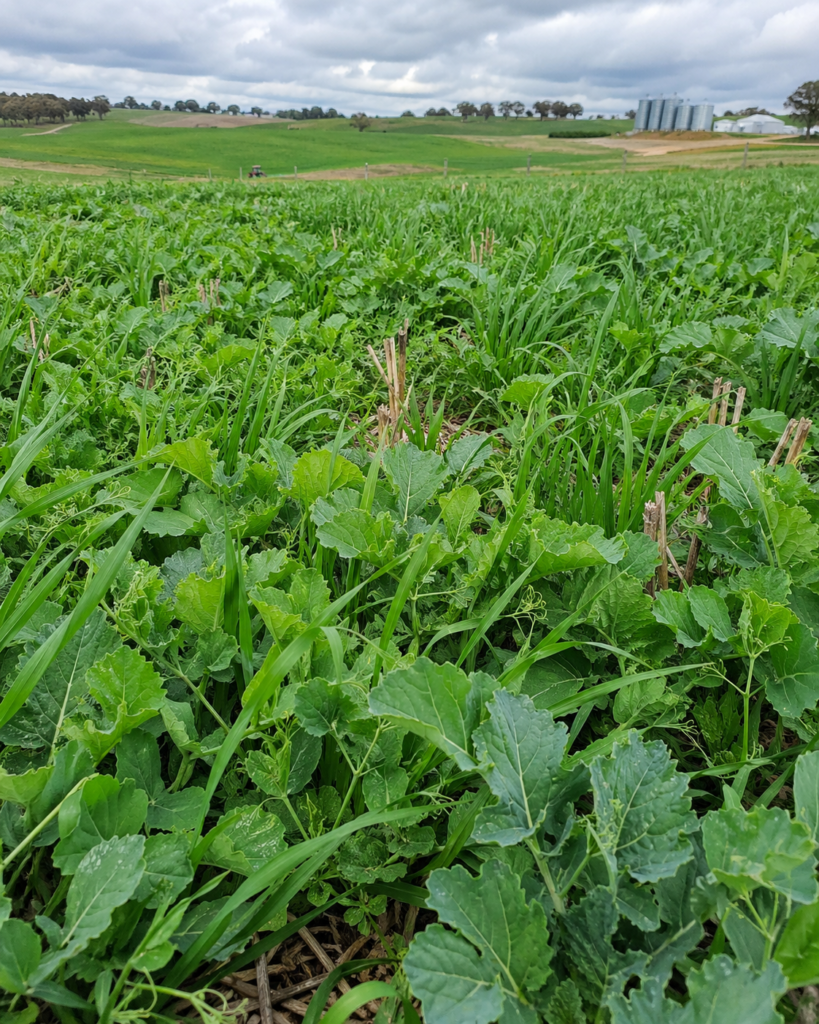
The real payoff, and this is what the more thoughtful growers keep pointing to, is the co-benefits. “Precision Pastures has always focused on the established production benefits from increasing soil carbon, such as improved pasture growth, soil biology and moisture retention. If we can get that right first, then the carbon credits will look after themselves” — that framing applies equally in cropping. Better soil organic matter means better moisture retention, which in a drying climate means better yields in marginal years. The carbon payment is a bonus. The resilience is the main prize.
The Vivians in Victoria’s Wimmera are a good current example — using biological inputs in combination with MAP and urea to boost yields while generating ACCUs. The carbon project is additive to a productivity story, not a substitute for one.
So is it paying off?
The honest verdict, for Australian grain growers in 2026:
It’s paying off modestly for farmers who were going to do these practices anyway — reduced tillage, better rotations, strategic cover cropping, careful nutrient management. For those growers, ACCUs are a useful income stream stacked on top of productivity gains. The numbers aren’t life-changing, but they’re no longer hypothetical.
It’s paying off significantly for southern canola growers supplying the EU biofuel market, even though most of them don’t think of themselves as regen ag producers. This is the largest existing “low-carbon premium” in the Australian grain system and it is real money.
It’s not yet paying off for growers who jumped into standalone soil carbon projects expecting transformation. The economics are marginal, the administrative burden is real, and the payoff is stretched out over years.
And it’s looming as a significant opportunity — not yet cashed, but visible — for growers positioning themselves to supply into domestic biofuel and SAF markets through the second half of the decade. The infrastructure is being approved. The offtake agreements are being drafted. The emissions-intensity metrics are being written into contracts.
The industry keeps asking whether regen ag “works”. It’s the wrong question. The better one is whether it’s being priced fairly — and in 2026, the answer is finally edging toward yes. Not generously, not uniformly, but fairly enough that ignoring the opportunity is starting to cost money.
That’s a genuine shift from the situation five years ago, when ignoring it was basically free. For an industry that usually moves one paddock-rotation at a time, that’s as fast as things ever change.