
Why Grain Handling Equipment Matters More Than Ever
Ask any grain farmer what separates a smooth harvest from a frustrating one and you will usually hear the same sort of answer: it is not just yield, and it is not just price. It is how efficiently the crop can be moved, stored, loaded, and kept in good condition once it comes off the header.
That is where grain handling equipment becomes absolutely central. Good equipment saves time, reduces labour pressure, limits grain damage, improves safety, and helps keep harvest rolling when every hour counts. Poorly chosen equipment does the opposite. It creates bottlenecks, slows trucks, increases losses, makes loading awkward, and adds stress at the exact time of year when most grain businesses can least afford it.
From a grain farmer’s perspective, grain handling equipment is not just a machinery purchase. It is part of the whole farm system. It affects harvest efficiency, storage management, transport turnaround, labour use, and ultimately the cost of getting grain from paddock to buyer.
Grain Handling Equipment Is About Flow, Not Just Machinery
One of the biggest mistakes people make when thinking about grain handling equipment is focusing too much on the machine itself rather than on grain flow.
A grain farm works best when grain flows smoothly from one stage to the next. It comes off the header, moves into chaser bins or field bins, gets loaded into trucks or shifted into storage, and then later gets moved out again to market. If one part of that chain is slow, awkward or unreliable, the whole system feels it.
That is why experienced grain farmers usually think less in terms of “What machine should I buy?” and more in terms of “Where is my bottleneck?” Sometimes the bottleneck is truck loading speed. Sometimes it is shifting grain out of a silo without too much labour. Sometimes it is the inability to handle different grain types cleanly. Sometimes it is the simple fact that one ageing auger is doing too many jobs.
The right grain handling equipment is the equipment that removes friction from the farm’s grain movement system.
The Main Types of Grain Handling Equipment on Grain Farms
Grain Augers
For many Australian grain farms, augers are still the backbone of everyday grain handling. They are familiar, widely used, and relatively straightforward. A good auger can do a lot of work across loading, unloading, filling silos, and general grain movement around the yard.
From a farmer’s point of view, the appeal of an auger is simple. It is practical, versatile, and can often be moved where needed without too much fuss. But augers also come with trade-offs. They can be harsher on grain than other equipment types, they can create more grain cracking in some situations, and they demand proper attention to safety.
For farms regularly handling seed grain, fragile pulses, or grain where presentation matters, auger damage can be a genuine consideration. That does not mean augers are the wrong choice. It just means the farm needs to be honest about what it is handling and what standard it needs to maintain.
Belt Conveyors
Belt conveyors have become a very attractive option for many grain growers, particularly those wanting gentler grain handling. They are often favoured where minimising grain damage matters, or where higher-value grain, seed, or pulses are part of the system.
From the farm gate view, the biggest selling point of a belt conveyor is that it handles grain more softly than a traditional auger. That can make a real difference where cracked seed coats, split grain, or handling damage can reduce quality. Belt conveyors can also be very efficient in some loading and outloading setups.
The trade-off is that they may involve a higher upfront cost, and they are not automatically the best answer for every farm. The best value tends to come when the farm has a clear need for gentle handling, repeatable efficiency, and a layout that suits conveyor use.
Chaser Bins
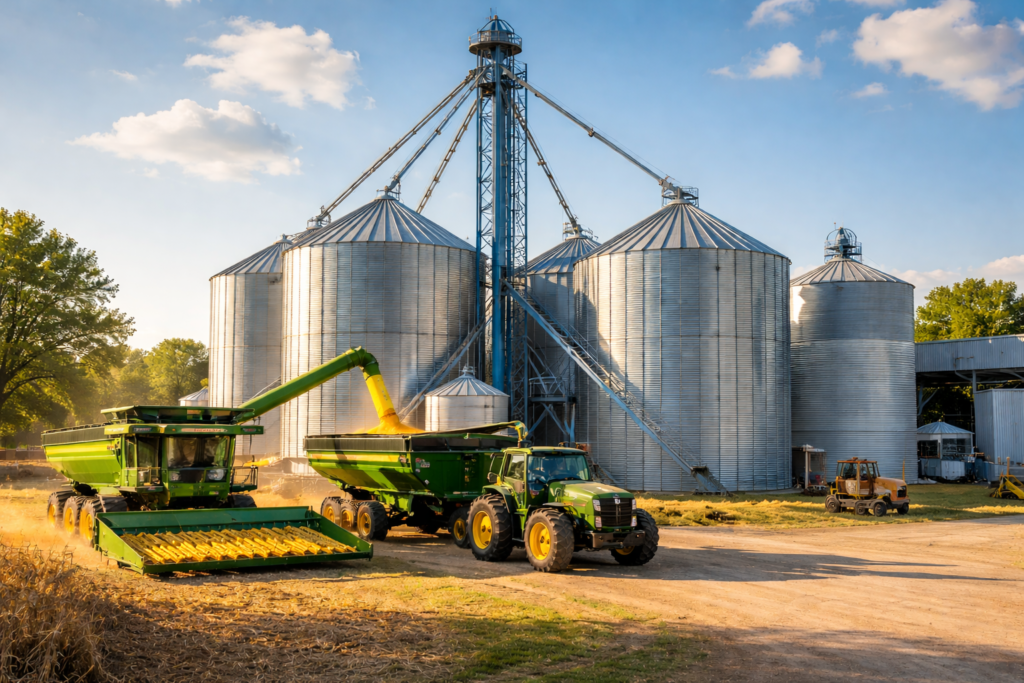
Strictly speaking, a chaser bin is not always the first thing people think of when discussing grain handling equipment, but from a grain farmer’s perspective it absolutely belongs in the conversation. The chaser bin is often the piece of equipment that keeps harvest moving.
Its value is obvious in the paddock. It reduces harvester downtime, improves header efficiency, and creates a buffer between the harvester and the truck. In a well-run system, the chaser bin is what allows grain to keep moving without headers waiting around for trucks to catch up.
The key question for growers is not whether chaser bins are useful. It is whether the size, capacity, unloading speed and tyre setup suit the scale of the operation. A chaser bin that is too small can become a frustration. One that is too large for the farm’s harvest pattern or soil conditions may not deliver the value expected.
Field Bins and Mother Bins
Field bins and mother bins can play an important role where harvest logistics are stretched or where trucks cannot always be exactly where they are needed. They give the farm extra breathing room and can help smooth out movement between paddock and road freight.
From a practical point of view, they are especially helpful when farms are spread out, truck availability is inconsistent, or several paddocks are coming off at once. They are not glamorous pieces of equipment, but they can solve very real harvest flow problems.
Silo Loading and Unloading Systems
Once grain is in storage, the handling job is far from over. In many cases, the real test of grain handling equipment comes later, when grain needs to be shifted out cleanly, safely and efficiently.
This is where silo unloaders, aeration-compatible loading setups, sweep arrangements, and well-planned outload points matter. Farmers who have been caught with awkward silo layouts or slow unload systems know how frustrating it is when stored grain becomes hard work to move. A storage setup that looked fine on paper can become a headache if every load-out takes too long or requires too much manual effort.
Choosing Grain Handling Equipment for Your Farm Size and System
Small and Medium Grain Farms Need Flexibility
For smaller and medium-sized grain farms, flexibility is often more valuable than having a large fleet of specialised handling equipment. One well-chosen auger or conveyor that can do several jobs well may be far more useful than multiple machines that each do one job but sit idle most of the year.
At this scale, value often comes from equipment that is easy to move, simple to maintain, and suited to both harvest and post-harvest work. The farm usually needs gear that can load trucks, fill silos, empty silos, and handle multiple grain types without turning day-to-day work into a complicated exercise.
Large Grain Farms Need Speed and Redundancy
Larger grain operations often reach a point where speed becomes just as important as flexibility. When harvest is big and timing is tight, the cost of a bottleneck is far greater. At that stage, growers often need higher-capacity equipment and a degree of redundancy.
Redundancy matters because breakdowns never happen at convenient times. A farm with only one critical grain handling machine can quickly find itself in trouble if that machine fails during harvest. Many experienced growers understand that backup capacity is not wasteful. It is insurance against downtime.
Grain Handling Equipment for Wheat, Barley, Canola and Pulses
Not all crops behave the same way, and this matters when choosing equipment.
Wheat and barley can usually tolerate a fair bit of ordinary handling if the system is well run, but even then, losses and cracking are worth keeping an eye on. Canola brings different challenges because it is small-seeded and unforgiving of poor sealing, leaks and messy handling. Pulses can be more sensitive again, especially where grain appearance and seed integrity matter.
From a grain farmer’s perspective, this is why a one-size-fits-all mindset can cause problems. Equipment that works perfectly well for bulk wheat movement may be less ideal for lentils, chickpeas, lupins or seed grain. The more crop diversity a farm has, the more important gentle handling, cleanliness, and changeover practicality become.
Grain Handling Equipment and Harvest Efficiency
Fast Harvest Systems Depend on Fast Grain Movement
A high-capacity header means very little if the grain cannot be taken away quickly enough. Plenty of growers have learned this the hard way. Modern harvest gear can move serious volume, and that means the supporting grain handling equipment has to keep up.
The best harvest systems are not just about header size. They are about matching the whole chain. If the chaser bin is too slow, trucks are too slow to load, or the yard system is too clumsy, harvest output suffers. In practical terms, many grain farms do not have a harvesting problem at all. They have a grain movement problem.
Loading Trucks Quickly Saves More Than Time
Truck loading speed is one of the most underrated parts of on-farm grain handling. Faster loading does not just save a few minutes. It helps improve freight efficiency, reduces waiting around, eases driver frustration, and allows the farm to make better use of labour.
When growers think about handling equipment from a profitability angle, truck turnaround deserves more attention than it often gets. A better loading setup may not look as exciting as a major machine purchase, but it can quietly improve the farm’s whole logistics performance.
Grain Handling Equipment Maintenance Matters More During Harvest
One truth in grain farming is that equipment problems become much more expensive once harvest is underway. A worn flight, tired belt, bearing issue, misaligned drive or neglected hydraulic problem may seem manageable before harvest, but it becomes far more serious when grain is coming off and everything depends on movement.
That is why grain handling equipment should be treated as serious harvest infrastructure, not just as background gear. Preventative maintenance matters. So does preseason inspection. Farmers who give their handling gear proper attention before the season usually save themselves far bigger headaches later.
Safety Around Grain Handling Equipment Cannot Be an Afterthought
Any honest article about grain handling equipment should say this clearly: safety matters just as much as capacity and cost.
Augers, belts, drive systems, PTOs, silo access points and moving grain all carry risks. The trouble on farms is that familiarity can breed complacency. Equipment that is used every day starts to feel ordinary, and that is often when corners get cut.
From a farmer’s point of view, the best equipment is not only productive. It is also equipment that is safe to operate, easy to position, simple to shut down, and less likely to encourage risky shortcuts. Safety is not separate from efficiency. In the long run, it is part of it.
How to Know When It Is Time to Upgrade Grain Handling Equipment
Most farms do not replace grain handling equipment just because something newer exists. They replace it when the old system is no longer keeping up, or when the cost of frustration starts outweighing the cost of the upgrade.
Usually the warning signs are obvious. Harvest is regularly slowed by grain movement. Truck loading takes too long. Grain damage is becoming a concern. Labour requirements are too high. Breakdowns are becoming more frequent. Stored grain is awkward to outload. One machine is doing too many jobs. The system works, but only just.
When those signs start stacking up, the question is no longer whether the current equipment can still function. The real question is whether it is still the right fit for the farm.
The Best Grain Handling Equipment Is the Equipment That Fits the Farm
There is no universal best grain handling equipment for every Australian grain farm. The right choice depends on scale, crop mix, storage setup, labour availability, freight pattern, yard layout, and how the business prefers to run harvest.
Some farms will get enormous value from a high-capacity auger. Others will benefit more from a belt conveyor system. Some need a bigger chaser bin. Some need a second machine rather than a replacement machine. Some do not need more capacity at all; they just need a smarter yard layout and a cleaner grain flow plan.
That is the farmer’s perspective in a nutshell. Grain handling equipment is not about buying the flashiest bit of gear in the catalogue. It is about building a system that keeps grain moving, protects quality, reduces stress, and helps the business perform better when it matters most.
Final Thoughts on Grain Handling Equipment for Grain Farmers
Good grain handling equipment pays for itself in ways that do not always show up neatly on a price tag. It saves time. It protects quality. It reduces frustration. It makes harvest smoother. It helps storage work better. It supports freight. It makes the whole grain business more efficient.
And on a grain farm, that matters. Because once the crop is ready, nothing is more valuable than a system that can handle it properly.